For more on early-childhood development, see NAEYC’s early learning resources, and browse more indoor activities for kids on Family Hobby Hub.
If your preschooler is constantly touching, squishing, pouring, and mixing everything in sight, that’s not a phase to redirect away from — it’s exactly the kind of play their brain is asking for. Sensory play, or hands-on activities that engage touch, sight, smell, and sometimes taste, is one of the simplest ways to support development at this age. Below are 18 sensory play ideas for preschoolers (ages 3–5), organized by type, plus a free printable sensory play checklist to help you keep track of favorites.
These sensory play ideas for preschoolers work well indoors or outside.
Why Sensory Play Matters for Preschoolers
Sensory play looks like simple messy fun, but early-childhood educators point to real developmental value behind it. NAEYC (the National Association for the Education of Young Children) notes that sensory experiences like sand and water play “can assist some children with calming down their bodies,” supporting self-regulation, and that sensory play areas are “wonderful environments to create conversations,” which supports language development as children narrate and describe what they’re doing. Rotating sensory play ideas for preschoolers every week or two keeps them feeling fresh.
In other words, the pouring, squishing, and mixing your preschooler can’t get enough of is quietly building focus, vocabulary, and calm — all at the same time. Most sensory play ideas for preschoolers use supplies you already have at home.
What You’ll Need
Sensory play doesn’t require a special kit. A basic supply rotation covers almost everything below: Early-childhood educators often recommend sensory play ideas for preschoolers as a foundation for classroom readiness.
- A large shallow bin or baking tray
- Dry rice, beans, or pasta (dyed or plain)
- Flour, salt, and oil (for dough recipes)
- Shaving cream or washable paint
- Small cups, spoons, and funnels
- A few drops of food coloring
- A towel or shower curtain for easy cleanup
1. Tactile & Texture Play
- Homemade playdough. A no-cook flour-salt-oil dough gives endless squishing, rolling, and shaping practice.
- Kinetic sand. Moldable but not sticky, kinetic sand is one of the least messy ways to get real tactile play indoors.
- Textured nature basket. Fill a basket with pinecones, smooth stones, bark, and leaves for open-ended touch-and-describe play.
- Shaving cream tray. Spread shaving cream on a tray for squishy, washable finger-drawing.
- Fabric scrap sorting. A bag of different fabric textures (fleece, silk, corduroy) invites sorting by “soft,” “rough,” or “bumpy.”
2. Taste-Safe Sensory Bins
- Edible dough. A dough made from peanut butter (or a nut-free alternative) and oats is safe if little ones taste-test while playing.
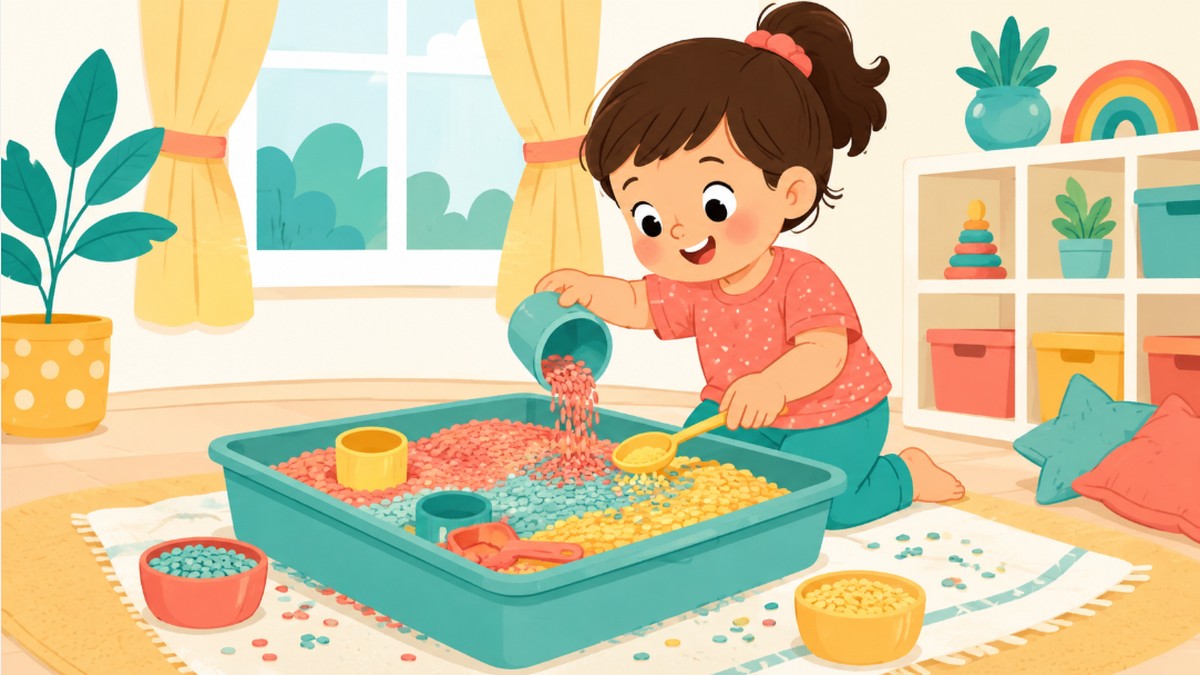
- Cereal or oat digging bin. Dry oats or cereal make a taste-safe base for scooping, pouring, and hiding small toys.
- Fruit and vegetable printing. Halved apples, celery, or peppers dipped in washable paint make edible-adjacent stamping fun.
- Jell-O or pudding finger paint. A taste-safe, squishy alternative to traditional paint for younger or more mouthy preschoolers.
3. Water & Pouring Play
- Water bead bins. Squishy, colorful water beads offer a novel texture that’s different from dry sensory materials.
- Bath or sink pouring station. Cups, funnels, and small pitchers turn bath time into a full pouring-and-measuring lab.
- Bubble play. Bubble solution and a variety of wands (or a whisk) makes for open-ended, giggle-inducing water play.
- Ice excavation. Freeze small toys in a container of water and let your preschooler use a spoon, salt, and warm water to melt them free.
4. Nature-Based Sensory Play
- Mud kitchen. An outdoor mud kitchen with old pots and utensils turns dirt and water into imaginative, fully sensory play.
- Leaf and petal sorting. Collected leaves, petals, and sticks sorted by color or size combine sensory play with early categorizing.
- Sand tray with tools. A shallow tray of sand with small rakes, cups, and molds supports both texture play and fine motor skills.
5. Messy Art Sensory Play
- Foam or bubble wrap painting. Painting with foam shapes or stamping with bubble wrap adds texture to a normal painting session.
- Salt or sand art. Drizzling glue in a shape, then sprinkling colored salt or sand on top, combines fine motor control with sensory texture.
Free Printable: Preschool Sensory Play Checklist
To make it easy to rotate through favorites without repeating the same bin every week, we made a free printable sensory play checklist with all 18 ideas grouped exactly as above. Check off what you’ve tried, and circle a few to plan for next week. A short daily dose of sensory play ideas for preschoolers adds up over the course of a week.
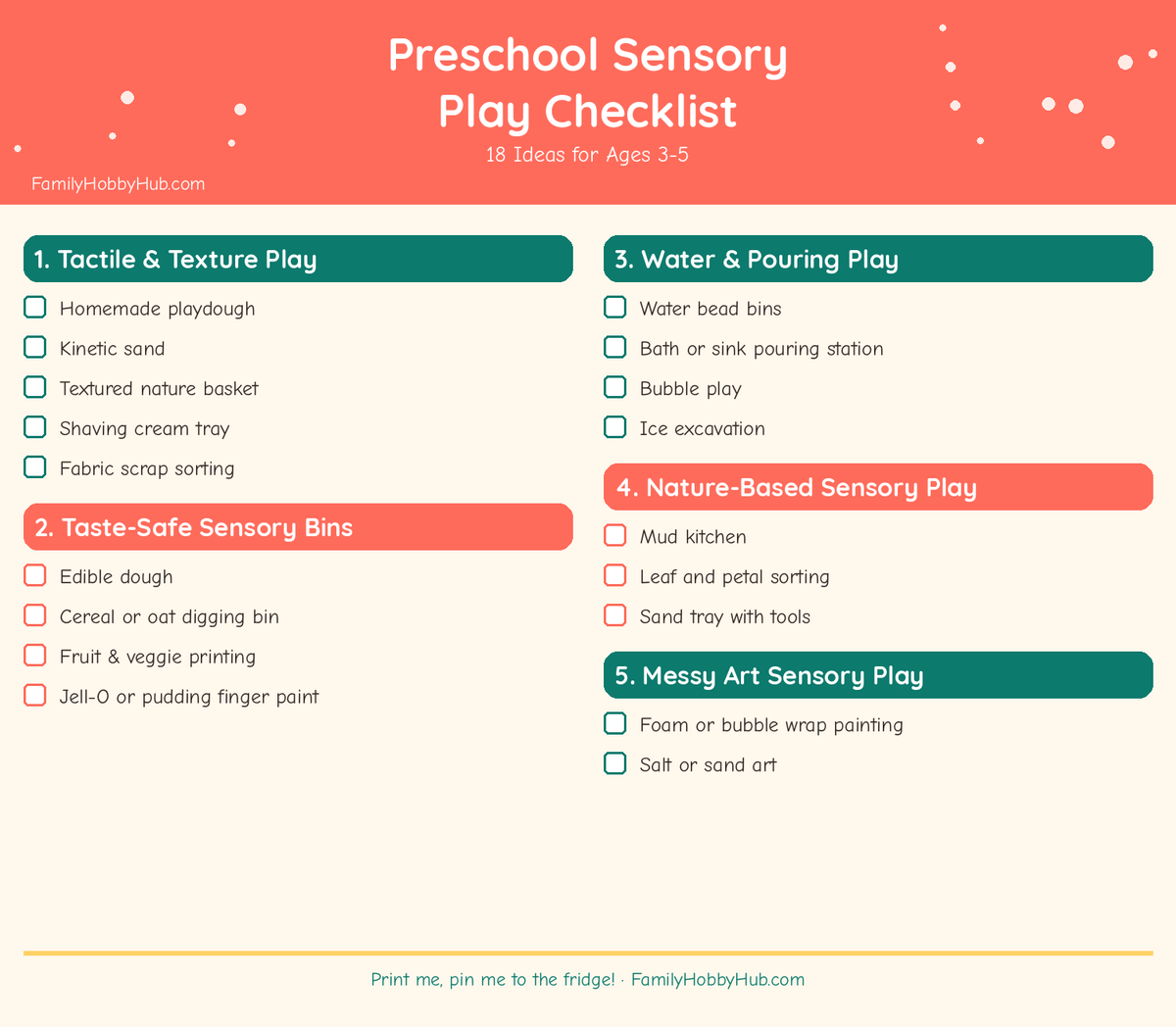
📥 Download the free Preschool Sensory Play Checklist (PDF) Many sensory play ideas for preschoolers double as calm, focused independent play.
Tips for Sensory Play with Preschoolers
- Set boundaries before you start. A quick “play stays in the bin” reminder heads off most of the mess before it happens.
- Choose taste-safe recipes for mouthier kids. If your preschooler still samples everything, lean on the taste-safe bin ideas above rather than restricting sensory play altogether.
- Let them lead the play. Resist the urge to direct exactly how the material should be used — open-ended exploration is where most of the benefit comes from.
- Prep for easy cleanup. A towel, shower curtain, or doing messier activities outside saves you from dreading sensory play time.
- Narrate and ask questions. Simple prompts like “how does that feel?” or “what happens if you add water?” turn play into a language-building conversation.
Sensory Play Ideas for Preschoolers: What the Research Says
Sensory play ideas for preschoolers aren’t just a way to pass time — they build real neural pathways. Early-childhood research consistently links rich sensory experiences with stronger language development, better emotional regulation, and improved problem-solving skills at this age. Preschoolers are still building the connections between their senses and their understanding of the world, and hands-on sensory play ideas for preschoolers give them repeated, low-stakes practice at exactly that kind of integration.
A child squishing playdough, pouring water between containers, or sorting textured objects by feel is doing genuine cognitive work, even though it looks like simple play from the outside. The best sensory play ideas for preschoolers require very little cleanup.
What makes sensory play ideas for preschoolers particularly valuable at this age is how open-ended they tend to be. Unlike a worksheet with one right answer, most sensory play ideas for preschoolers have no fixed outcome, which lets a child explore at their own pace and follow their own curiosity. That open-endedness also makes sensory play ideas for preschoolers naturally inclusive — a child who’s anxious about “getting it wrong” in a structured task often relaxes completely once there’s no wrong way to squish, pour, or sort.
Choosing sensory play ideas for preschoolers based on their interests keeps engagement high.
| Sense Engaged | Example Sensory Play Ideas for Preschoolers | Skill Built |
|---|---|---|
| Touch | Texture bins, playdough, water beads | Fine motor, tactile discrimination |
| Sight | Color sorting, light table play | Visual discrimination, early categorization |
| Sound | Musical instrument exploration | Auditory processing |
| Smell/Taste | Taste-safe sensory bins, scented playdough | Sensory integration |
Setting Up a Sensory Play Space at Home
You don’t need a dedicated playroom for sensory play ideas for preschoolers to work — a towel or shower curtain spread on the kitchen floor turns any room into a contained mess zone in under a minute. Keeping a small bin of go-to supplies (dried rice or beans, a few scoops and containers, some washable paint) means sensory play ideas for preschoolers are always just a few minutes of setup away rather than a whole production that requires planning ahead.
These sensory play ideas for preschoolers work well indoors or outside.
Outdoor spaces make even easier venues for sensory play ideas for preschoolers, since spills and mess matter far less on a patio or in a backyard than they do indoors. Mud kitchens, water tables, and sand play all scale beautifully outside, and cleanup is often as simple as a garden hose. If weather or space genuinely doesn’t allow for outdoor play, a large plastic tray or a repurposed under-bed storage bin makes a workable contained indoor alternative for smaller-scale sensory play ideas for preschoolers.
Rotating sensory play ideas for preschoolers every week or two keeps them feeling fresh.
Sensory Play Ideas for Preschoolers with Sensitivities
Not every preschooler enjoys the same textures, and that’s worth taking seriously rather than pushing through. Some kids are genuinely sensitive to certain textures — slimy, sticky, or grainy sensations can feel overwhelming rather than fun for a subset of preschoolers.
For these kids, start sensory play ideas for preschoolers with tools rather than bare hands: tongs, scoops, paintbrushes, or spoons let a texture-sensitive child engage with a sensory bin without direct skin contact, and many kids warm up to touching the material directly once they’ve had time to observe it with a tool first. Most sensory play ideas for preschoolers use supplies you already have at home.
It also helps to let a sensitive child watch a sibling or friend enjoy sensory play ideas for preschoolers before being expected to participate themselves. Pressure to jump straight in tends to backfire, while permission to simply watch — with an open invitation to join whenever they’re ready — often leads to a child trying the activity on their own timeline, sometimes within the same session. Early-childhood educators often recommend sensory play ideas for preschoolers as a foundation for classroom readiness.
Common Mistakes with Sensory Play Ideas for Preschoolers
A frequent mistake with sensory play ideas for preschoolers is treating every session like it needs a specific outcome or a finished product. Sensory play works best when there’s no goal beyond the exploration itself — resist the urge to direct a child toward “making something” out of a sensory bin, and let the pouring, squishing, and sorting be the entire point. Sensory play ideas for preschoolers lose a lot of their developmental value when they’re steered toward a predetermined result.
Another common mistake is over-preparing to the point where the activity never actually happens. Sensory play ideas for preschoolers don’t need elaborate setups — a bin of dry rice and a few spoons is genuinely enough for most preschoolers to stay engaged for fifteen or twenty minutes. Waiting for the “perfect” themed sensory bin often means the activity gets postponed indefinitely, while a simple five-minute setup gets used regularly.
Finally, don’t assume mess-aversion means a child dislikes sensory play ideas for preschoolers altogether. Some kids who resist getting their hands directly in a wet or sticky material happily engage with the same sensory play ideas for preschoolers using tools, scoops, or gloves. Offering an alternative way to participate, rather than concluding a child “just doesn’t like sensory play,” usually opens the door to eventual hands-on participation.
Sensory Play Ideas for Preschoolers on a Budget
Most sensory play ideas for preschoolers cost next to nothing. Dry rice, dried beans, oats, and pasta all make excellent sensory-bin bases and are already sitting in most kitchen pantries. A few plastic cups, spoons, and funnels from the kitchen drawer cover most of the “tools” needed across this entire list. Water play requires nothing more than a basin, a towel, and a few containers of different sizes — no special equipment required.
Nature-based sensory play ideas for preschoolers are free by definition: pinecones, leaves, sand, mud, and rocks from a backyard or local park make some of the richest sensory experiences on this whole list, and they change with the seasons, which naturally keeps things feeling fresh without any extra cost. Rotating between pantry-based indoor sensory play ideas for preschoolers and free outdoor nature-based ones covers an enormous range of textures and experiences without spending anything at all.
Sensory Play Ideas for Preschoolers in the Classroom vs. at Home
Preschool teachers often rely on a rotating sensory table as one of the busiest, most requested stations in the classroom, and the same sensory play ideas for preschoolers translate easily to a home setting with a little scaling down. A classroom sensory table might hold several gallons of material for a whole group; at home, a single dishpan-sized bin covers the same experience for one or two kids. The core value — open-ended tactile exploration — stays exactly the same whether it’s happening in a classroom or on a kitchen floor.
One advantage of doing sensory play ideas for preschoolers at home rather than in a classroom is the ability to let a single activity run much longer. A preschool teacher managing twenty kids on a schedule often has to rotate stations every ten or fifteen minutes, while a parent at home can let one sensory bin hold a child’s attention for as long as it’s working, with no bell signaling it’s time to move on. That extended, uninterrupted stretch of focused play is itself valuable, separate from whatever specific skill the activity is building.
Siblings of different ages can often share the same sensory play ideas for preschoolers with only small adjustments — a baby or young toddler gets supervised access to the same texture bin with larger, safer pieces, while an older preschool sibling handles the smaller components. This kind of shared-table play also builds a social dimension into sensory play ideas for preschoolers, since kids frequently narrate and demonstrate for each other in ways that extend the activity well past what either child would sustain alone.
Seasonal rotation keeps a home sensory bin feeling new without any extra cost — dried leaves and pinecones in fall, snow or ice cubes in winter, flower petals in spring, and sand or water in summer all turn the same basic bin into a completely different experience throughout the year. Tying a sensory activity loosely to the season outside also gives preschoolers an easy, concrete way to notice and talk about seasonal change, folding a bit of science observation into what still feels like pure play.
Frequently Asked Questions
What is sensory play and why is it important for preschoolers?
Sensory play is any hands-on activity that engages the senses — touch, sight, smell, sometimes taste — and it supports self-regulation, language development, and fine motor skills at this age. A short daily dose of sensory play ideas for preschoolers adds up over the course of a week.
How messy does sensory play have to be?
Not very — kinetic sand, textured nature baskets, and fabric sorting are all low-mess options if you’d rather avoid a full sensory bin setup. Many sensory play ideas for preschoolers double as calm, focused independent play.
What sensory activities are safe for preschoolers who still put things in their mouths?
Edible dough, cereal digging bins, and Jell-O or pudding finger paint are all taste-safe options that let mouthier preschoolers explore without a safety concern. The best sensory play ideas for preschoolers require very little cleanup.
How often should preschoolers do sensory play?
A few times a week is a reasonable target, though many preschoolers happily do some form of sensory play daily if materials are left accessible as an open-ended option. Choosing sensory play ideas for preschoolers based on their interests keeps engagement high.
Final Thoughts
Sensory play doesn’t need a Pinterest-perfect setup to work — a bin of dry rice and a spoon accomplishes just as much real developmental good as an elaborate station. Print the checklist, pick two or three ideas to rotate through this week, and let the mess do the work. These sensory play ideas for preschoolers work well indoors or outside.
Pin This for Later!
Save this to your Pinterest board so you can find it again next time you need it.

About the Author: Family Hobby Hub
The Family Hobby Hub team researches and puts together simple, screen-free activity ideas for parents, grandparents, and caregivers — indoor play and sensory activities, backyard and outdoor games, on-the-go entertainment for car rides and waiting rooms, and easy learning and STEM activities for kids of different ages. Every guide is built around things most families already have around the house, takes only a few minutes to set up, and comes with a free printable checklist or activity sheet whenever possible. We are not child development specialists, educators, or licensed childcare professionals, and our activity ideas are general suggestions for family fun rather than professional guidance. Always supervise children during any activity and use your own judgment about what is appropriate for your child's age, interests, and abilities.