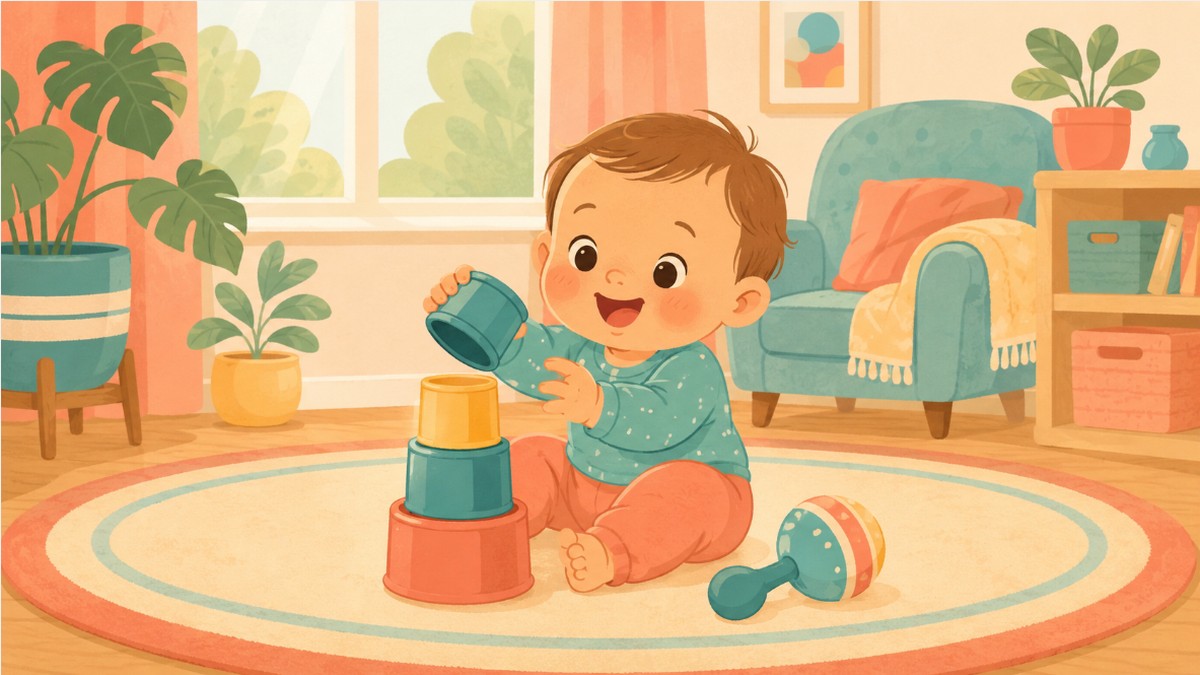
For more on infant development, see the CDC’s developmental milestones guide, and browse more indoor activities for kids on Family Hobby Hub.
Somewhere between rolling over and taking those first wobbly steps, your baby is turning into a tiny scientist — testing what happens when a spoon hits the floor, how a stacking cup fits inside another, and whether that face in the mirror will smile back. Below are 15 easy activities for babies ages 6-12 months, organized by the kind of development they support, plus a free printable play tracker to help you keep track of what your baby has tried.
These easy activities for babies work well with things you already have at home.
Why Play Matters So Much in the First Year
It’s tempting to think of “real” learning as something that starts later, once a child can talk or count. But at 6-12 months, a baby’s brain is already doing enormous work through play. The CDC’s developmental milestones for this age range include simple, playful actions like “bangs two things together” — a milestone that sounds trivial but actually reflects real progress in hand coordination, cause-and-effect understanding, and bilateral movement. Rotating easy activities for babies every week or two keeps them feeling fresh and engaging.
None of the activities below require special toys or a curriculum. Babies this age learn primarily through repetition, sensory input, and interaction with a caregiver’s face and voice — so the simplest version of any activity is usually the right one. Most easy activities for babies only need five to ten minutes to be worthwhile.
What You’ll Need
Almost everything here uses things you already have at home: Pediatricians often recommend easy activities for babies as a simple way to support early development.
- Stacking cups or nesting bowls
- A muffin tin and a few soft balls
- Board books with thick pages
- A small unbreakable mirror
- Soft fabric scraps of different textures
- Empty tissue boxes and scarves
- A shallow bin for supervised taste-safe exploring
1. Sensory & Touch Play
- Texture basket. Fill a basket with safe household items of different textures — a soft washcloth, a smooth wooden spoon, a bumpy silicone teether — and let your baby explore each one with supervision.
- Scarf pull. Stuff a few silky scarves into an empty tissue box so your baby can practice pulling them out one at a time — a simple, endlessly repeatable favorite.
- Taste-safe bin. A shallow bin of cooked, cooled pasta or oatmeal lets babies who mouth everything explore texture safely under close supervision.
- Water play in the tub. A few unbreakable cups during bath time let your baby practice pouring and splashing in a naturally taste-safe setting.
2. Movement & Motor Skills
- Stacking cups. Nesting and knocking down a stack of cups builds hand-eye coordination and an early sense of size and order.
- Muffin tin ball drop. Dropping a soft ball into each cup of a muffin tin practices the pincer-adjacent grasp and cause-and-effect thinking.
- Tummy time reach. Place a favorite toy just out of reach during tummy time to encourage reaching, pushing up, and early crawling motions.
- Banging drum. An overturned pot and a wooden spoon let your baby practice the “bangs two things together” motion CDC milestones describe, with a satisfying sound as a bonus.
3. Language & Social Play
- Peekaboo. The classic never gets old — the momentary “disappearance” and reappearance of your face builds an early understanding of object permanence.
- Mirror play. Sitting your baby in front of an unbreakable mirror and narrating what you both see (“there’s your nose!”) supports both language and early self-awareness.
- Board book reading. Even a few minutes of naming pictures in a thick-paged board book builds vocabulary long before your baby can talk back.
- Name and touch. Gently touch and name your baby’s body parts (“this is your foot”) during diaper changes — a few seconds of language-rich routine.
4. Cause & Effect Play
- Rattle and shake. Simple rattles or a sealed container with dry rice inside teach that an action (shaking) produces a predictable result (sound).
- Push-and-roll ball. Rolling a soft ball back and forth introduces turn-taking and the idea that objects move in response to a push.
- Pop-up toys. Toys with a simple button or lever that make something pop up are excellent, low-frustration cause-and-effect practice for this age.
Free Printable: Baby Play Milestone Tracker
To make it easy to rotate through all 15 activities without forgetting what you’ve already tried, we made a free printable play tracker with every idea on this list grouped exactly as above. Check one off as your baby tries it, or use it to plan a new activity each day. A short daily dose of easy activities for babies adds up meaningfully over the course of a week.
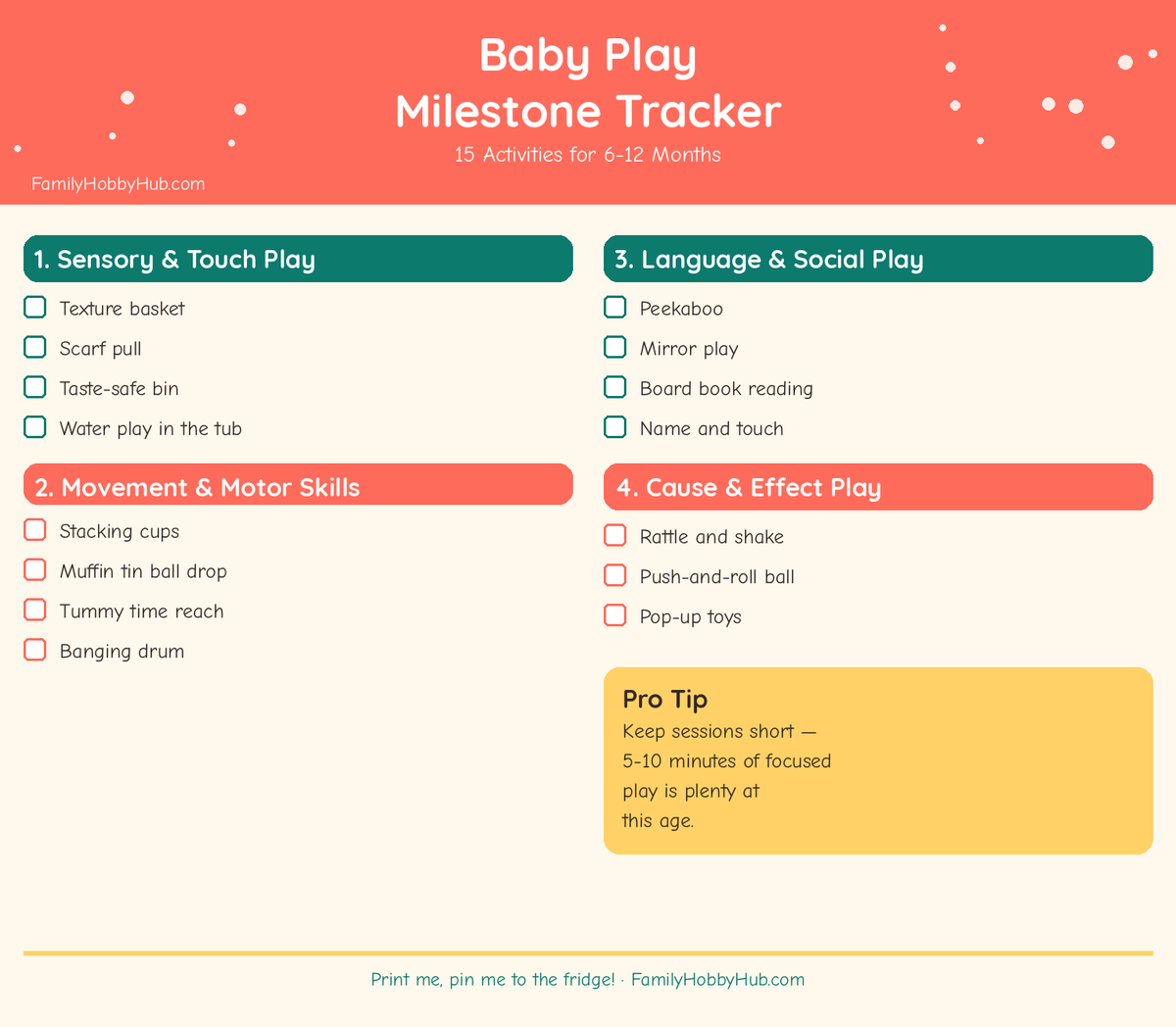
📥 Download the free Baby Play Milestone Tracker (PDF) Many easy activities for babies double as a calm way to connect before naptime.
Tips for Playing with Babies 6-12 Months
- Follow their lead. If your baby wants to bang the same cup for ten minutes straight, that’s not a lack of imagination — it’s exactly the repetition their brain needs.
- Keep sessions short. Five to ten minutes of focused play is plenty at this age — babies this young naturally cycle in and out of engagement.
- Supervise anything small. Rattles, small balls, and fabric scraps all need to stay within arm’s reach for a baby who mouths objects.
- Narrate constantly. You don’t need special vocabulary flashcards — simply describing what your baby is doing (“you’re stacking!”) builds language in the background.
- Don’t worry about “doing it right.” There’s no wrong way to bang two cups together — the value is in the repetition and interaction, not a perfect technique.
Easy Activities for Babies: Following Developmental Cues
The best easy activities for babies are the ones that match where your baby actually is developmentally, not necessarily their exact age in months. A 7-month-old who’s already pulling to stand is ready for different easy activities for babies than a 7-month-old who’s just mastering sitting independently. Watching what your baby is naturally trying to do — reaching, pulling, babbling, mouthing objects — tells you far more about which easy activities for babies to offer next than a strict age chart ever will.
The best easy activities for babies require almost no setup or cleanup.
It also helps to remember that babies this age cycle through skills unevenly. A baby might seem to master a new easy activities for babies milestone one week and regress slightly the next, especially around growth spurts or developmental leaps. This is completely normal, and it means the easy activities for babies list below works best treated as a flexible menu rather than a strict month-by-month checklist. Choosing easy activities for babies based on their current skills keeps the challenge level just right.
| Rough Age | Emerging Skill | Best Easy Activities for Babies |
|---|---|---|
| 6-8 months | Sitting, early reaching | Sensory play, simple cause-and-effect toys |
| 8-10 months | Crawling, pulling to stand | Movement play, object permanence games |
| 10-12 months | Cruising, early words | Language play, stacking and dropping games |
Turning Everyday Routines into Easy Activities for Babies
You don’t need a dedicated play session for every one of these easy activities for babies to count — plenty of ordinary daily routines already double as rich developmental play. Bath time offers built-in sensory and cause-and-effect exploration, diaper changes are a natural moment for simple language play (“where’s your nose?”), and mealtime introduces new textures and self-feeding practice that count among the most valuable easy activities for babies of the whole day. These easy activities for babies work well with things you already have at home.
Grocery trips, laundry folding, and other household chores can also become easy activities for babies with almost no extra effort — narrating what you’re doing, handing over a safe object to hold and explore, or simply making eye contact and talking through a task all build language and attachment. The cumulative effect of these small, woven-in moments often matters more than any single structured activity session. Rotating easy activities for babies every week or two keeps them feeling fresh and engaging.
Common Mistakes with Easy Activities for Babies
A frequent mistake with easy activities for babies is offering too much stimulation at once. Babies this age are still learning to filter and process input, and a cluttered play area with too many toys out at once can actually make it harder for a baby to focus on any single easy activities for babies option. Rotating just two or three toys at a time, kept in easy reach, generally holds attention far better than a whole basket dumped out on the floor.
Another mistake is assuming a short attention span means an activity has failed. Most easy activities for babies genuinely only hold interest for a few minutes at this age, and that’s completely normal rather than a sign something’s wrong. Following your baby’s lead — moving on once they lose interest, rather than trying to redirect them back to the “planned” activity — respects their natural attention span and keeps play feeling positive rather than like a chore for either of you.
Finally, don’t skip safety basics in the name of a good easy activities for babies session. Anything small enough to be a choking hazard should stay out of reach for babies who mouth objects, which at this age is most of them. When in doubt, size up rather than down, and always supervise directly during any of these easy activities for babies rather than leaving a baby unattended even briefly.
Easy Activities for Babies on a Budget
Most easy activities for babies cost little to nothing. Empty cardboard boxes, plastic containers with lids, wooden spoons, and measuring cups from the kitchen drawer make excellent, free additions to a baby’s play rotation. A muffin tin and a few soft balls turns into a simple dropping-and-fetching game. Crinkly fabric scraps or a clean sock stuffed with rice make a satisfying homemade sensory toy that costs nothing beyond materials already in the house.
Household mirrors are another free, high-value resource for easy activities for babies — babies this age are often fascinated by their own reflection, and simple games like naming body parts while looking in a mirror together combine language, social connection, and self-awareness in one easy activities for babies session that requires no supplies at all.
Easy Activities for Babies and Sibling Play
An older sibling can turn even simple easy activities for babies into something richer, since babies this age are natural imitators and often watch an older child more closely than they watch an adult. Inviting a preschool or school-age sibling to “show the baby” a simple game — stacking blocks, rolling a ball back and forth, making silly faces — gives the older child a meaningful role while the baby gets extra social and language exposure from a peer rather than only from a parent.
Just keep an eye on any small pieces an older sibling’s toys might introduce, since what’s safe for a five-year-old isn’t always safe for a baby who still mouths everything.
Sibling-assisted easy activities for babies also buy parents a few minutes of hands-free time, which can be genuinely valuable during a busy day. A five-minute supervised “big kid teaches baby” session, even something as simple as reading a board book together, often entertains both children at once and builds a sibling bond alongside whatever developmental skill the activity happens to target.
How Long Should Easy Activities for Babies Last?
There’s no fixed rule for how long any single session of easy activities for babies should run — babies this age typically engage with a single activity for anywhere from two to ten minutes before losing interest, and that range is completely normal across the 6-12 month window. Rather than aiming for a specific duration, watch your baby’s cues: turning away, fussing, or losing eye contact with the activity all signal it’s time to switch to something new rather than push through.
Over the course of a day, several short bursts of easy activities for babies — five here, ten there, spread across naps and feedings — add up to meaningful cumulative playtime without needing to carve out one long dedicated block. This piecemeal approach tends to fit far more realistically into a baby’s actual daily rhythm than trying to schedule one extended “playtime” the way you might with an older child.
Travel and disrupted routines don’t have to mean skipping easy activities for babies altogether — a small travel bag with a few lightweight, familiar items (a soft book, a rattle, a stacking cup or two) means you can offer a comforting, recognizable activity even away from home. Babies this age often find novelty stressful during travel, so leaning on familiar easy activities for babies rather than introducing brand-new ones during a trip tends to go over better, saving the new stuff for once you’re back in a settled routine.
Keeping a simple log of which easy activities for babies your child responds to best can be surprisingly useful, especially once you’re deep into the newborn-fog months and struggling to remember what worked yesterday. A quick note in your phone, or the printable tracker included with this post, turns a foggy memory of “something with the box” into a reliable go-to the next time you need a quick win.
Frequently Asked Questions
What activities are good for a 6-month-old versus a 12-month-old?
A 6-month-old typically enjoys simpler sensory and reaching activities, while a 12-month-old can usually manage more complex cause-and-effect toys like push-and-roll balls or simple stacking — but there’s a wide range of normal, so let your baby’s interest guide which activities you lean into. Most easy activities for babies only need five to ten minutes to be worthwhile.
How much playtime does a baby need each day?
There’s no strict daily quota — short, frequent bursts of interactive play spread throughout the day tend to work better than one long scheduled session for babies this age. Pediatricians often recommend easy activities for babies as a simple way to support early development.
Are these activities safe for babies who still put everything in their mouths?
Choose the taste-safe versions (cooked pasta bins, board books, silicone teethers) for unsupervised moments, and keep anything with small parts strictly to supervised play within arm’s reach. A short daily dose of easy activities for babies adds up meaningfully over the course of a week.
What if my baby loses interest in an activity quickly?
That’s completely normal at this age — attention spans are naturally short. Simply moving to the next activity on the list (or repeating a favorite from yesterday) works just as well as pushing through one activity longer. Many easy activities for babies double as a calm way to connect before naptime.
Final Thoughts
You don’t need a shelf of developmental toys to give your baby a rich first year of play — a few stacking cups, a mirror, and some narrated peekaboo cover most of what matters. Print the tracker, try one or two new ideas this week, and enjoy watching those tiny discoveries add up. The best easy activities for babies require almost no setup or cleanup.
Pin This for Later!
Save this to your Pinterest board so you can find it again next time you need it.

About the Author: Family Hobby Hub
The Family Hobby Hub team researches and puts together simple, screen-free activity ideas for parents, grandparents, and caregivers — indoor play and sensory activities, backyard and outdoor games, on-the-go entertainment for car rides and waiting rooms, and easy learning and STEM activities for kids of different ages. Every guide is built around things most families already have around the house, takes only a few minutes to set up, and comes with a free printable checklist or activity sheet whenever possible. We are not child development specialists, educators, or licensed childcare professionals, and our activity ideas are general suggestions for family fun rather than professional guidance. Always supervise children during any activity and use your own judgment about what is appropriate for your child's age, interests, and abilities.