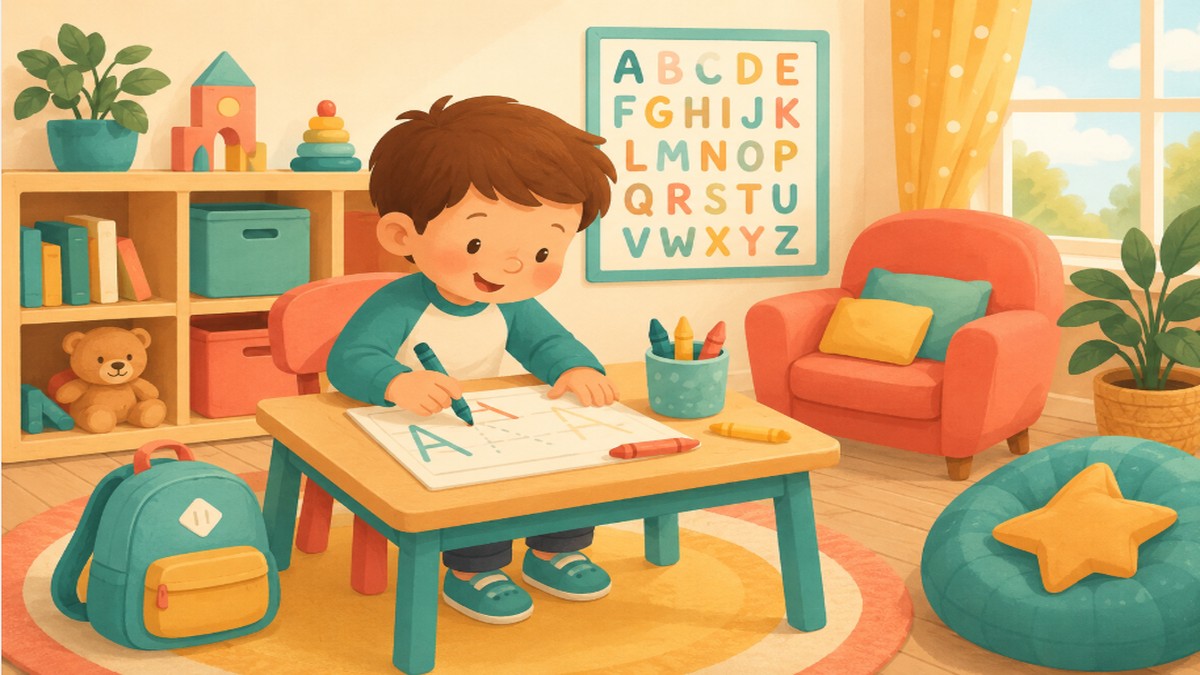
For general guidance on school readiness, see this CDC overview of child development milestones, and check out our more hands-on activity ideas for kids.
Kindergarten readiness isn’t really about knowing every letter of the alphabet before the first day of school — it’s a broader mix of skills, and some of the most important ones have nothing to do with academics at all. Below are 18 kindergarten readiness activities for ages 4-5, organized by skill area, plus a free printable readiness checklist to track progress.
What “Readiness” Actually Means
It’s easy to fixate on letters and numbers, but early-childhood guidance is clear that readiness is much wider than that. As one resource on the topic puts it, “self-care and social and emotional skills are important for kindergarten readiness, too” — meaning a child who can zip their own coat, wait their turn, and follow a two-step direction is just as “ready” as one who can already count to 20.
The activities below are grouped into four skill areas so you can round out whichever your child needs the most practice with, rather than drilling letters alone.
What You’ll Need
Nothing here requires a workbook or a curriculum — most of it is everyday materials and everyday moments:
- Paper, crayons, and safety scissors
- A deck of cards or dice
- Alphabet magnets or letter flashcards (optional)
- A small backpack for practicing independence routines
- Board games with simple turn-taking rules
1. Letters and Early Literacy
- Name writing practice. Learning to write their own first name is one of the most useful early-literacy skills for the first weeks of school.
- Letter hunt around the house. Search for a specific letter on cereal boxes, mail, or books to build letter recognition in a low-pressure way.
- Daily read-aloud time. Reading together builds vocabulary and story sense long before a child can read independently.
- Rhyming word games. Taking turns naming words that rhyme with a given word builds phonological awareness, a strong predictor of early reading success.
- Sound-matching “I spy.” Play “I spy something that starts with the same sound as ‘ball'” to connect sounds to letters playfully.
2. Numbers and Early Math
- Counting everyday objects. Counting stairs, snacks, or toys out loud builds number sense far more naturally than a worksheet.
- Shape hunt. Spot circles, squares, and triangles around the house or during a walk to build shape recognition.
- Simple sorting and grouping. Sorting toys or laundry by color or size introduces early categorization, a building block for later math thinking.
- Number writing practice. Tracing and writing numbers 1-10 builds the same fine motor pathway as letter writing.
- Board games with dice. Simple board games that use dice quietly build number recognition and one-to-one counting through play.
3. Fine Motor and Self-Care Skills
- Scissor practice. Cutting along straight and curved lines builds the hand strength kids will need for cutting and writing tasks at school.
- Practicing zippers and buttons. Independently managing a coat or backpack is a genuinely useful skill for the first weeks of kindergarten.
- Pencil grip practice. Coloring and simple tracing activities naturally build the grip strength needed for later writing.
- Packing their own backpack. Letting your child practice putting items in and taking them out of a backpack builds independence for drop-off routines.
4. Social-Emotional and Following Directions
- Two-step direction games. “Simon Says” and similar games practice listening to and following multi-step instructions, a core classroom skill.
- Turn-taking games. Any simple board or card game builds patience and turn-taking, both essential for a classroom setting.
- Practicing goodbyes. Role-playing a calm drop-off goodbye at home can ease separation anxiety before the real first day.
- Clean-up routines. Practicing “when playtime ends, toys go back in the bin” builds the same routine-following expected in a classroom.
Kindergarten Readiness Activities by Skill Area
Not every child needs equal focus on every category, so here’s a quick guide to which kindergarten readiness activities to prioritize based on what a child already shows strength in.
| If your child struggles with | Focus on | Example |
|---|---|---|
| Sitting still / following directions | Social-emotional activities | Two-step direction games |
| Holding a pencil | Fine motor activities | Scissor and pencil grip practice |
| Recognizing letters or numbers | Early literacy and math | Letter hunt, counting objects |
Mixing kindergarten readiness activities across all four categories, rather than drilling only the weakest area, keeps sessions varied enough that a child stays engaged instead of associating readiness practice with one repetitive task.
Making Kindergarten Readiness Activities a Daily Habit
Spreading kindergarten readiness activities across short daily sessions in the months before school starts tends to work better than a few long cram sessions right before enrollment. Ten to fifteen minutes a day, rotating through the categories above, builds skills gradually without turning practice into a battle.
A simple visible checklist — even just the printable below — keeps kindergarten readiness activities on track and makes progress visible to a child who likes seeing things checked off.
Free Printable: Kindergarten Readiness Checklist
To make it easy to track progress across all four skill areas, we made a free printable checklist with all 18 activities grouped exactly as above. Check off each skill as your child practices it, and revisit any that need a little more time.
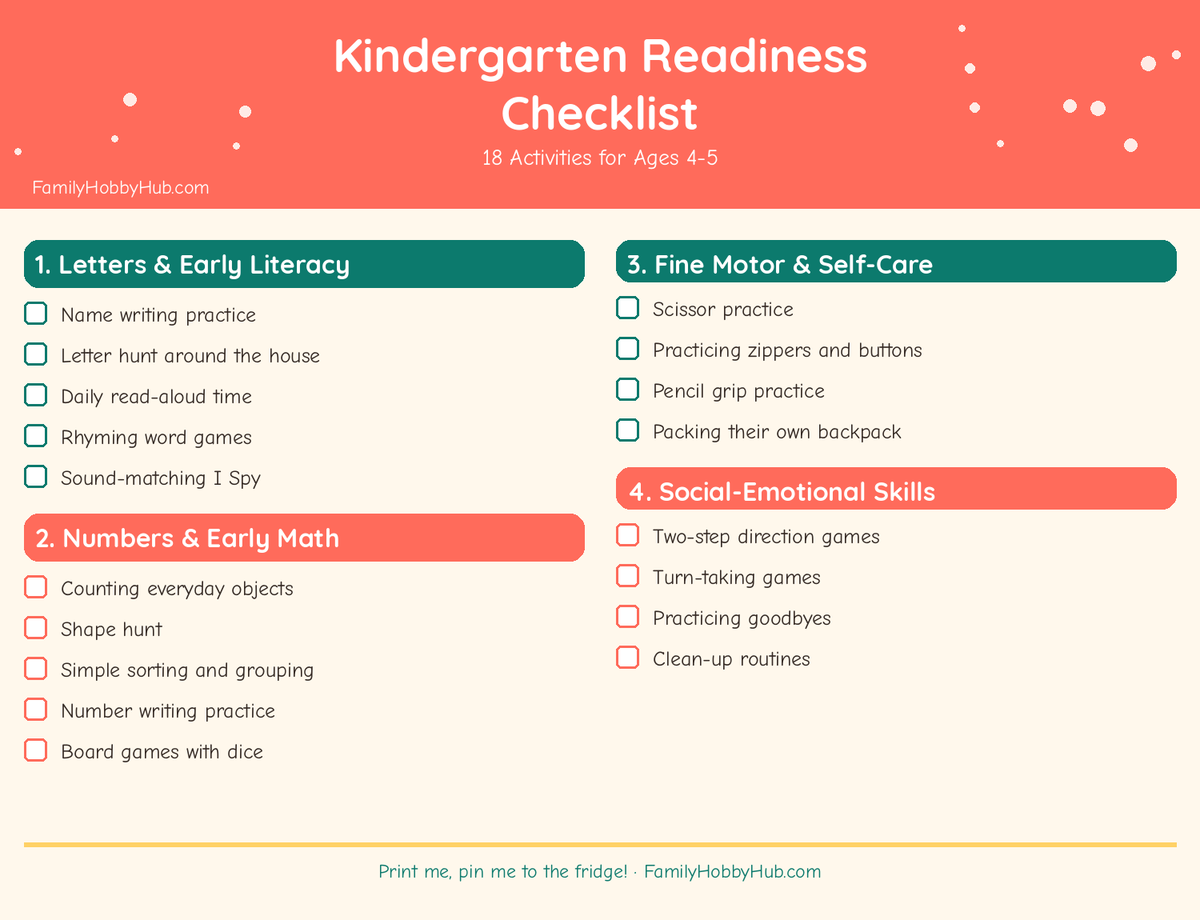
📥 Download the free Kindergarten Readiness Checklist (PDF)
Tips for Building Kindergarten Readiness
- Practice in short, regular bursts. A few minutes daily works far better than one long cram session — readiness builds gradually, not overnight.
- Weave it into daily routines. Counting stairs or naming letters on a cereal box during breakfast counts just as much as dedicated “practice time.”
- Prioritize self-care skills, not just academics. A child who can manage their own coat and follow directions often adjusts faster than one who can already read.
- Keep it playful. Turning practice into a game keeps kids engaged far longer than a worksheet-style approach at this age.
- Talk to their future teacher if you’re worried. Every child develops at a different pace, and a kindergarten teacher can offer perspective on what actually matters most in the first weeks.
Common Mistakes with Kindergarten Readiness Activities
One frequent mistake is treating kindergarten readiness activities as purely academic — letter and number recognition matter, but social-emotional skills like turn-taking and following two-step directions are just as predictive of a smooth start to school.
Another common mistake is cramming kindergarten readiness activities into the final weeks before school starts. Skills like pencil grip and scissor control build gradually over months, not days, so starting early gives a much less stressful runway.
Skipping the “why” is a third pitfall. Kindergarten readiness activities land better when framed as fun games rather than tests, since a child who feels evaluated tends to disengage faster than one who’s just playing.
Budget-Friendly Kindergarten Readiness Activities
Most kindergarten readiness activities cost nothing beyond paper, a pencil, and everyday household objects for counting practice. Board games already in the house double as turn-taking and following-directions practice without any new purchase.
For families on a budget, prioritizing the free options — name writing, counting objects around the house, practicing zippers and buttons — keeps kindergarten readiness activities essentially free all the way up to the first day of school.
Kindergarten Readiness Activities on a Busy Weeknight
Not every kindergarten readiness activity needs a long dedicated session. A quick round of I Spy for sound-matching or five minutes of counting toys during cleanup fits easily into a weeknight routine, making kindergarten readiness activities realistic even on packed days.
Keeping a mental shortlist of the fastest kindergarten readiness activities makes it easy to slot one in before dinner or during bath time, rather than saving practice only for a rare free afternoon.
Kindergarten Readiness Activities and Screen-Free Time
Most kindergarten readiness activities double as an easy screen-free stretch of the day — board games, letter hunts, and counting games are naturally more hands-on and social than anything on a screen, so they fill the same “keep them occupied” role parents often reach for a device for.
Building a short rotation of kindergarten readiness activities into the after-dinner window gives the evening a natural screen-free anchor while doubling as school prep.
Kindergarten Readiness Activities: What to Skip If You’re Short on Time
If there’s only room for a few kindergarten readiness activities instead of all eighteen, name writing practice and counting everyday objects give the best return for the least prep — both use materials already on hand and need almost no setup.
Save the more involved kindergarten readiness activities, like practicing a full backpack-packing routine, for a day when there’s more time to walk through each step without rushing.
Kindergarten Readiness Activities: A Simple Prep Checklist
Before starting any of the kindergarten readiness activities above, a short prep pass helps: gather paper and pencils, pick a quiet spot without distractions, and decide which single skill area is the day’s focus. A little prep up front means kindergarten readiness activities can start the moment a child is willing, instead of losing momentum hunting for supplies.
Kindergarten Readiness Activities for Multiple Kids at Once
Kindergarten readiness activities work well for playdates or siblings close in age — board games and counting games especially, since turn-taking practice actually benefits from having more than one child involved. For a bigger group, turning kindergarten readiness activities into a friendly relay or rotation keeps everyone engaged without one child waiting too long for a turn.
Kindergarten Readiness Activities: Building a Routine
Families who keep kindergarten readiness activities going consistently, rather than in scattered bursts, often find it helps to anchor them to something already happening — a post-dinner ten minutes, or a Saturday morning slot. Attaching kindergarten readiness activities to an existing part of the day means they don’t need to compete for a fresh dedicated block of time.
Even a modest daily rhythm is enough to work through the full range of kindergarten readiness activities well before the first day of school, without turning the months beforehand into a stressful countdown.
Kindergarten Readiness Activities: Involving a Reluctant Learner
Some kids resist anything that feels like “practice,” especially if kindergarten readiness activities are framed as schoolwork rather than play. Letting a reluctant child choose which activity to try, or turning a letter hunt into a timed game, usually lowers resistance more than presenting kindergarten readiness activities as a required task.
Starting with the more game-like options, like board games or I Spy, is often the easiest way to ease a reluctant learner into kindergarten readiness activities before working up to more focused pencil-and-paper practice.
Kindergarten Readiness Activities: Talking to the Teacher
Many kindergarten teachers are happy to share what their specific classroom expects on day one, and that information can help focus kindergarten readiness activities on what actually matters for a particular school rather than a generic checklist. A quick email or a question at an orientation night is often enough to get a useful answer.
Some schools also publish their own readiness guidelines, which can make it easier to prioritize kindergarten readiness activities that match exactly what a child’s future classroom will expect from day one.
Kindergarten Readiness Activities: Keeping a Simple Log
A quick note on the calendar or a checked-off printable after each session makes it easy to track which kindergarten readiness activities have been covered and which still need attention. Looking back over a few weeks makes it obvious where to focus next, so planning kindergarten readiness activities gets easier over time instead of guessing where a child stands.
Emotional Readiness Matters Just as Much
Being able to separate from a parent without a prolonged meltdown, ask an adult for help when something is confusing, and recover from a small disappointment without shutting down are all quietly important for a smooth first few weeks. These skills develop through everyday moments — a playdate disagreement, a lost game, a new environment — more than through any single structured exercise.
Practicing short separations ahead of time, like a few hours at a friend’s house or a trial morning at a preschool program, can make the actual first day feel far less overwhelming than it would as a complete first-time experience.
A Note on Comparing Kids to Each Other
Every child arrives at kindergarten with a different mix of strengths, and a child who reads early might still need more support with sitting still, while a child who struggles with letters might be the most socially confident kid in the room. Resisting the urge to compare progress against a sibling or a friend’s child keeps the process focused on what a particular child actually needs rather than an arbitrary benchmark.
Kindergarten Readiness Activities: When to Get Extra Support
If a child is well behind peers on multiple fronts despite consistent kindergarten readiness activities at home, a conversation with a pediatrician or an early-childhood screening can rule out or identify a specific developmental need early, when support tends to be most effective. This isn’t a sign anything went wrong with the kindergarten readiness activities themselves — some kids simply need a bit more targeted help, and catching that early makes a real difference.
Kindergarten Readiness Activities: Where to Find Free Printables
Beyond the checklist included in this post, plenty of free kindergarten readiness activities and worksheets are available from library programs, school district websites, and early-education nonprofits, which can add variety without any added cost. Rotating in a new free printable every couple of weeks keeps kindergarten readiness activities feeling fresh rather than repetitive over a long stretch of months.
A local library’s early-literacy program is also worth checking — many run free story times and readiness-focused activities that pair well with what’s practiced at home.
Kindergarten Readiness Activities: A Sample Week
A sample week might look like this: Monday, a letter hunt around the house; Tuesday, counting practice during snack time; Wednesday, a board game for turn-taking; Thursday, scissor practice with an old magazine; Friday, a mix of whatever felt most fun that week. Rotating kindergarten readiness activities this way, rather than repeating the same one daily, covers more ground across the months leading up to school.
Weekends can stay lighter — a trip to the library, a puzzle, or simply free play — since kindergarten readiness activities don’t need to fill every single day to be effective. Consistency over a few months matters far more than intensity in any one week.
Frequently Asked Questions
Does my child need to know all their letters before kindergarten?
No — most kindergarten programs expect a range of starting points and build letter knowledge further in class; social-emotional and self-care skills matter just as much at the start.
My child seems behind on some of these skills — should I be worried?
Kids develop these skills at different rates, and a few gaps at this age are completely normal. Focus on steady, playful practice rather than comparing to a strict timeline.
How much time should we spend on readiness activities each day?
Ten to fifteen minutes of focused practice, woven into everyday moments like meals or car rides, is plenty — consistency matters more than duration.
What’s the single most useful skill to focus on first?
Following two-step directions tends to have an outsized impact on how smoothly the first weeks of kindergarten go, since so much of a classroom day runs on instructions.
Final Thoughts
Kindergarten readiness is less about racing through a checklist of academic milestones and more about building a well-rounded set of everyday skills, a little at a time. Print the checklist, pick one skill area to focus on this week, and trust that steady, playful practice adds up by the first day of school.
Pin This for Later!
Save this to your Pinterest board so you can find it again next time you need it.

About the Author: Family Hobby Hub
The Family Hobby Hub team researches and puts together simple, screen-free activity ideas for parents, grandparents, and caregivers — indoor play and sensory activities, backyard and outdoor games, on-the-go entertainment for car rides and waiting rooms, and easy learning and STEM activities for kids of different ages. Every guide is built around things most families already have around the house, takes only a few minutes to set up, and comes with a free printable checklist or activity sheet whenever possible. We are not child development specialists, educators, or licensed childcare professionals, and our activity ideas are general suggestions for family fun rather than professional guidance. Always supervise children during any activity and use your own judgment about what is appropriate for your child's age, interests, and abilities.