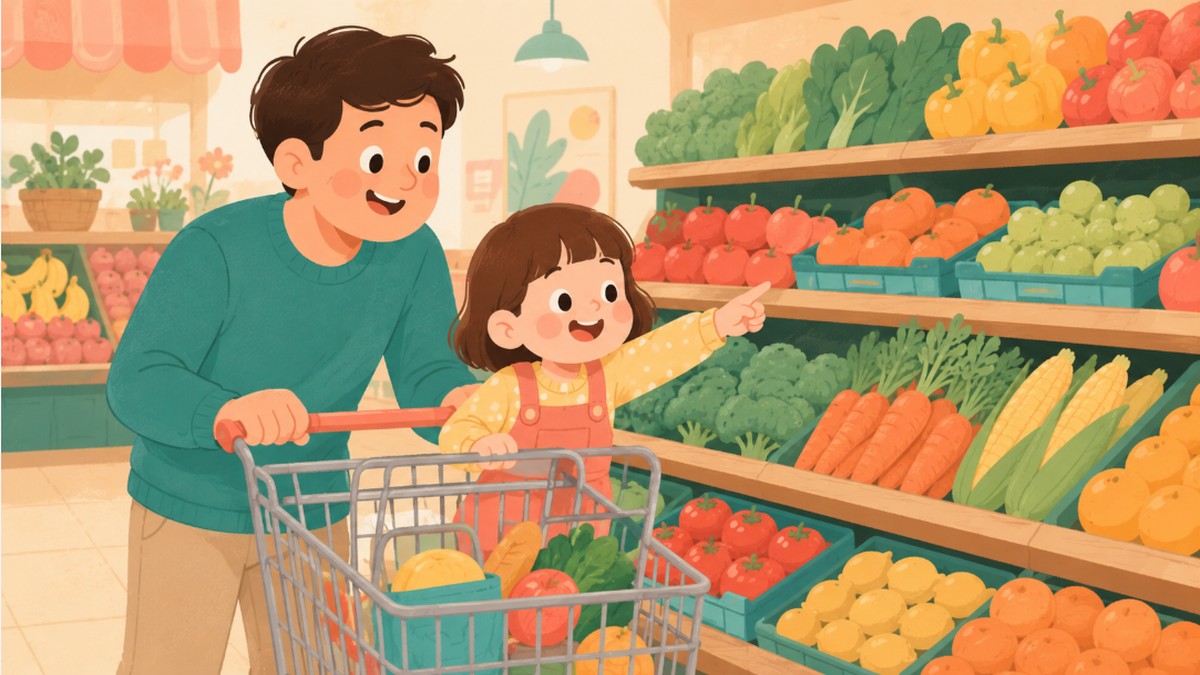
An ordinary trip to buy milk and bananas can turn into one of the easiest learning opportunities of the week — no extra time, no extra planning, no screen required. Below are 16 grocery store activities for kids that turn a routine errand into counting, reading, and observation practice, organized by type, plus a free printable scavenger hunt checklist to bring along.
Why Grocery Store Activities for Kids Are Worth the Extra Two Minutes
Reading Rockets, a national literacy initiative, puts it simply: “a simple trip to the grocery store can turn into a real learning experience” for a young child — the aisles are full of labels to read, numbers to compare, and categories to sort, all in a setting kids already visit regularly. That’s exactly the idea behind grocery store activities for kids: instead of treating the trip as time to get through, a few small prompts turn it into hands-on practice with skills a child is already working on at home or in preschool.
The grocery store activities for kids below are grouped by the kind of skill they build, so you can pick the ones that match what your child is currently learning — early letters, counting, or just staying engaged for a twenty-minute errand.
There’s a practical payoff for parents too: a child who has a job to do — spotting letters, counting apples, comparing prices — is a child who isn’t asking to grab things off the shelf or racing down the aisle. Grocery store activities for kids double as a genuinely effective way to make the whole trip go more smoothly for everyone.
It also helps to think of grocery store activities for kids as a rotating menu rather than a fixed script. Some weeks a quick counting game is all you need; other weeks, especially longer shopping trips, a full scavenger hunt checklist gives a child enough to do for the entire visit. Mixing it up keeps the routine from feeling repetitive to either of you.
What You’ll Need
Almost nothing beyond the store itself and a way to keep track:
- A printed grocery store scavenger hunt checklist (see below) and a pen
- A small notepad, if your child likes to write things down
- A shopping list your child can help hold or read from
- A reusable bag they can help carry or pack
1. Counting & Math Games
- Count the apples (or anything). Ask your child to count out exactly how many of an item goes in the bag — a simple, repeatable counting task built into nearly every aisle.
- Price-ending hunt. Challenge your child to find a price tag ending in a specific number, like 9 or 5 — a playful way to practice reading numbers on the shelf.
- Estimate the total. Before checkout, have an older child guess what the total will come to, then compare their guess to the receipt.
- Weigh-it-yourself produce game. Let your child place produce on the self-weigh scale and read the number and price together.
2. Letter & Literacy Games
- Alphabet aisle hunt. Spot a product that starts with each letter of the alphabet, one letter at a time, working through the store — one of the most popular grocery store activities for kids because it naturally fills an entire trip.
- Read the aisle sign. Ask your child to read (or sound out) the category words on each overhead aisle sign as you pass.
- Spot the sight word. Pick one simple word your child is learning (like “milk” or “fresh”) and see how many times they can spot it on packaging.
- Rhyme-the-item game. Take turns naming a grocery item and a word that rhymes with it, even a silly made-up one.
3. Job & Helper Tasks
- List holder. Give your child the shopping list (written or picture-based for younger kids) and let them cross off items as they go into the cart.
- Item finder. Send your child to spot a specific item nearby while you’re a few feet away, well within sight — a small independence task inside a supervised trip.
- Bagger’s helper. At checkout, let your child help sort items into bags by type (cold items together, produce together).
- Loyalty scanner. Handing your child the store loyalty card or coupon to give the cashier makes them feel like part of the transaction.
4. Sensory & Observation Games
- Color hunt in produce. Challenge your child to find one item of every color of the rainbow in the produce section — a fast, colorful version of grocery store activities for kids that works even with a toddler in the cart seat.
- Guess the smell. Near the bakery or coffee section, take a moment to notice and guess what’s creating the smell.
- Texture hunt. Find something bumpy, something smooth, and something soft (with permission to gently touch) across a few aisles.
- Cart temperature check. Ask your child to sort what’s already in the cart into “cold,” “cool,” and “doesn’t matter” — a simple sorting task that also teaches why frozen items go in last.
Free Printable: Grocery Store Scavenger Hunt Checklist
To make it easy to bring these grocery store activities for kids along on your next trip, we made a free printable scavenger hunt checklist with all 16 ideas grouped exactly as above. Keep a folded copy in your bag or attached to a clipboard in the cart.
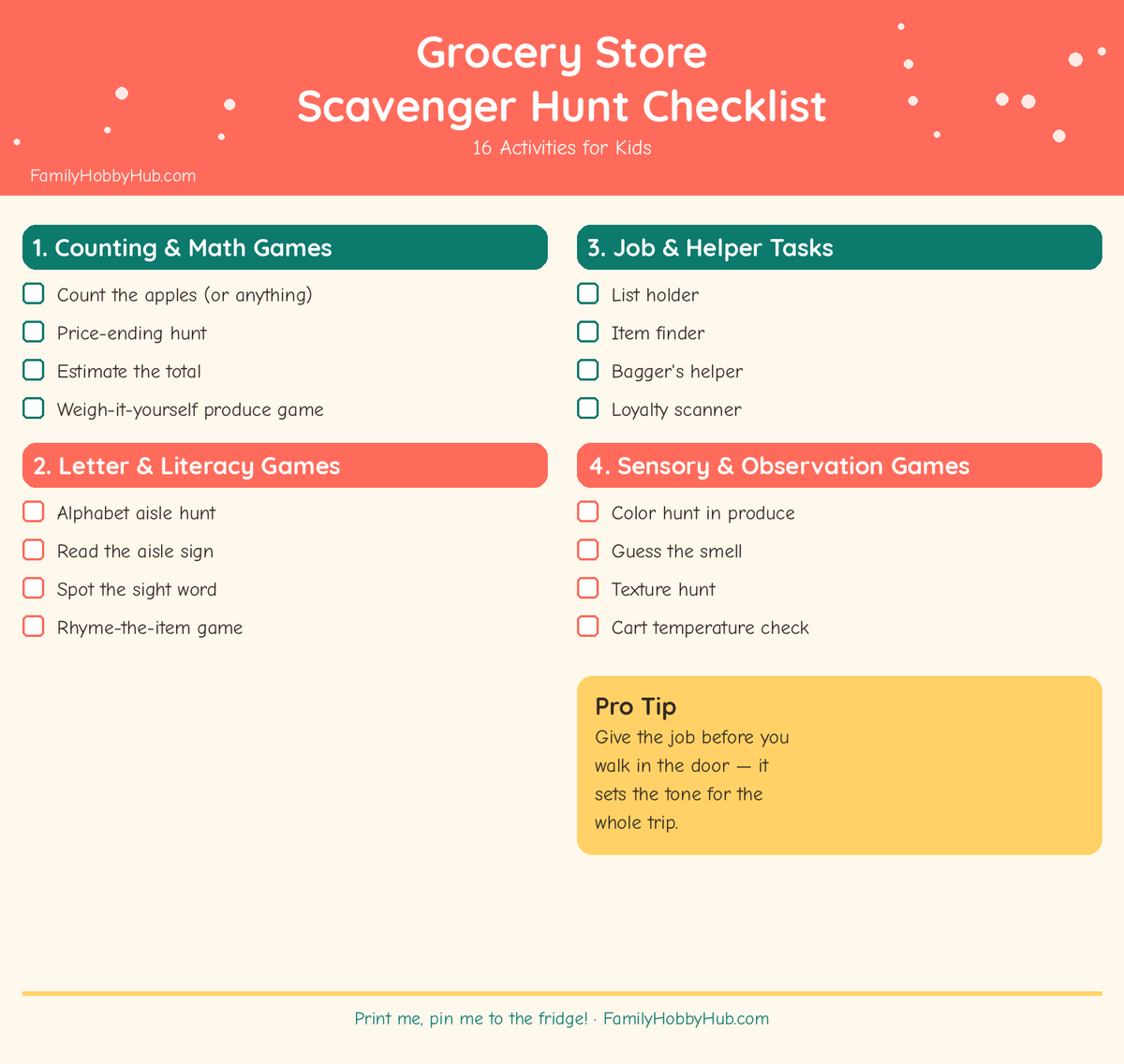
📥 Download the free Grocery Store Scavenger Hunt Checklist (PDF)
Budget-Friendly Tips
Every one of these grocery store activities for kids costs nothing beyond the printed checklist — there’s no extra toy or app to buy, since the “materials” are simply the products already on the shelves. If you want a small prop, a clipboard and a cheap pen kept in the car or diaper bag is the only real purchase worth making, and it can be reused for every future trip.
Tips for Shopping with More Than One Kid
When more than one child is along, split up the grocery store activities for kids so each child has their own job rather than competing for the same one — one child holds the list, another does the color hunt, a third checks off the scavenger hunt sheet. For siblings close in age, turning the price-ending hunt or the alphabet aisle hunt into a friendly “who finds five first” round keeps both kids engaged without one simply copying the other’s answers.
A carpool or playdate trip to the store works too — assign each visiting child a different category of grocery store activities for kids (one on counting, one on letters, one on colors) so the group covers more ground together than any one child would alone, and compare notes at checkout about what everyone found.
| Age Range | Best Grocery Store Activities for Kids | Trip Length They Can Cover |
|---|---|---|
| 2-4 years | Color hunt, texture hunt, counting apples | 10-15 minutes |
| 5-7 years | Alphabet aisle hunt, read the aisle sign, list holder | 20-30 minutes |
| 8-10 years | Price-ending hunt, estimate the total, item finder | 30-45 minutes |
As a general rule, younger kids do best with grocery store activities for kids that have an immediate, visible answer — a color, a texture, a number of items in a bag — while older kids can handle the slower ones that involve comparing, estimating, or reading full price tags across an entire trip.
Looking for more screen-free ways to fill time out and about? See our screen-free car ride activities for the drive there and back, or browse our quiet activities for kids in waiting rooms for other errands that involve some downtime.
Tips for Smoother Grocery Trips with Kids
- Give the job before you walk in. Assigning a role at the car, before the doors even open, sets the tone better than trying to introduce grocery store activities for kids once things are already chaotic.
- Keep the list short and visual for younger kids. A few pictures or simple words works better than a long written list for a child who isn’t reading fluently yet.
- Let them make one real choice. Picking which apple or which loaf of bread gives a small, genuine sense of ownership over the trip.
- Save the treat request for the list, not the checkout line. Deciding together in advance whether there’s room for one treat avoids a checkout-aisle negotiation.
- End with a specific compliment. Naming exactly what went well (“you found every letter on our list!”) makes grocery store activities for kids feel like a genuine accomplishment, not just a way to pass time.
Frequently Asked Questions
What age can kids start doing grocery store activities?
Even a two-year-old in the cart seat can join in with simple versions of these grocery store activities for kids, like a color hunt or counting a few items, while older kids can manage a full scavenger hunt checklist on their own.
What if my child gets bored halfway through the trip?
Switch to a different category of grocery store activities for kids rather than repeating the same one — a child who’s tired of counting might still be interested in a texture hunt or a color hunt in the produce section.
Do these work for a quick trip, not just a full grocery haul?
Yes — pick just one or two of these grocery store activities for kids for a five-minute stop, like a single alphabet hunt or helping hold one item, rather than trying to fit in the whole checklist.
How do I keep this from turning into asking for things at every aisle?
Giving a clear job upfront — list holder, item finder, colors hunter — tends to redirect that instinct toward the actual grocery store activities for kids rather than the snack aisle, though it’s still fine to have one agreed-upon treat built into the plan.
Can these work at other stores too, not just the grocery store?
Yes — most of these grocery store activities for kids adapt easily to a pharmacy run, a hardware store trip, or a farmers market, since the underlying skills (counting, letter spotting, sorting) don’t depend on the specific store.
Final Thoughts
The next grocery run doesn’t have to be a countdown until you’re back in the car. Print the scavenger hunt checklist, hand your child one small job, and let a few minutes of grocery store activities for kids turn a routine errand into something they actually look forward to. Start with just one or two of these grocery store activities for kids on your very next trip and see which ones stick before trying to fit in the whole list.

About the Author: Family Hobby Hub
The Family Hobby Hub team researches and puts together simple, screen-free activity ideas for parents, grandparents, and caregivers — indoor play and sensory activities, backyard and outdoor games, on-the-go entertainment for car rides and waiting rooms, and easy learning and STEM activities for kids of different ages. Every guide is built around things most families already have around the house, takes only a few minutes to set up, and comes with a free printable checklist or activity sheet whenever possible. We are not child development specialists, educators, or licensed childcare professionals, and our activity ideas are general suggestions for family fun rather than professional guidance. Always supervise children during any activity and use your own judgment about what is appropriate for your child's age, interests, and abilities.