For more on child development milestones, see the CDC’s developmental milestones guide, and browse more indoor activities for kids on Family Hobby Hub.
Somewhere between first steps and the first day of preschool, your toddler’s hands are quietly doing some of the most important development work of their whole childhood. Fine motor skills — the small, precise movements of fingers and hands — are what let a child hold a spoon, turn a page, zip a jacket, and eventually hold a pencil. The good news: you don’t need a curriculum or fancy toys to build these skills.
Below are 20 fine motor activities for toddlers (ages 1–3), organized by skill type, plus a free printable activity tracker to help you keep track of what your toddler has tried. These fine motor skill activities for toddlers work well with things you already have at home.
Why Fine Motor Play Matters at This Age
It’s easy to think of fine motor skills as something that matters later, once a child is holding a pencil at school. But the groundwork gets laid much earlier. The CDC’s developmental milestones for 2-year-olds note that by this age, most toddlers are already “holding something in one hand while using the other hand,” such as holding a container and taking the lid off, and are “eating with a spoon” — both genuinely complex hand-coordination skills that took months of repetition to build. Rotating fine motor skill activities for toddlers every week or two keeps them from getting boring.
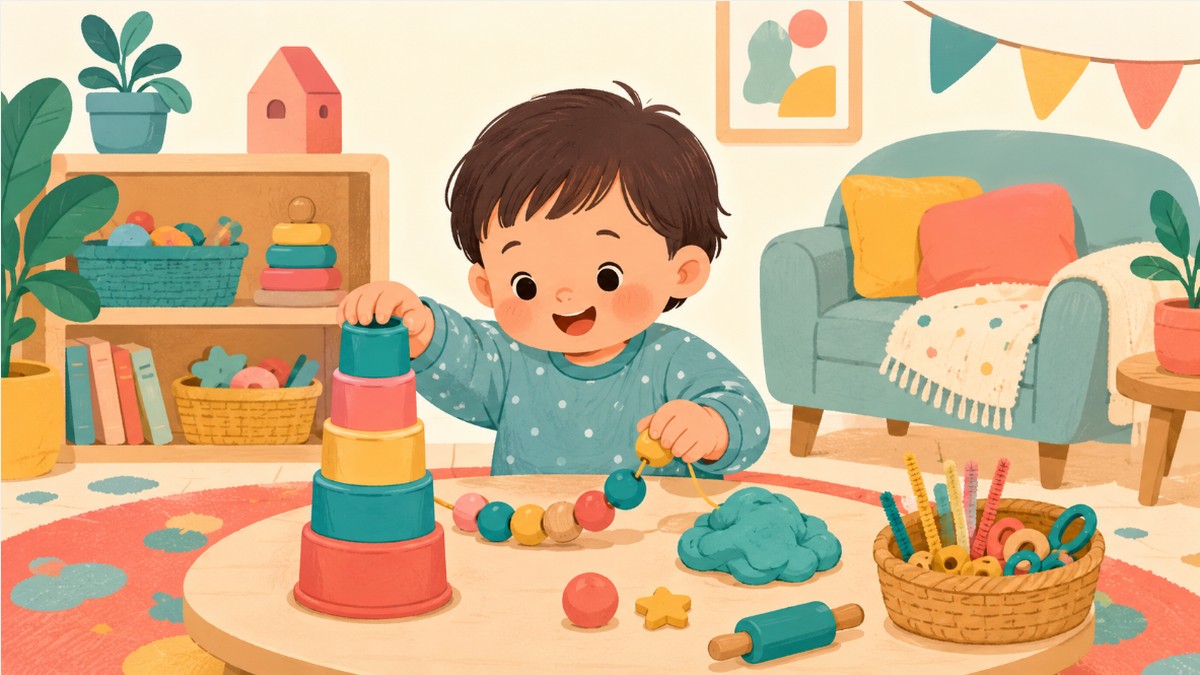
Every time your toddler squeezes a sponge, stacks a block, or pinches a piece of playdough, they’re practicing the same small-muscle control that milestone depends on. None of the activities below require special equipment — just a little supervision and a tolerance for mess. Most fine motor skill activities for toddlers only need five to ten minutes to be worthwhile.
What You’ll Need
Most of these activities use things you already have. A small “fine motor basket” is worth keeping stocked with: Occupational therapists often recommend fine motor skill activities for toddlers as an easy, low-cost way to build hand strength.
- Clothespins or spring-loaded tongs
- Playdough or homemade dough
- Small containers with lids (yogurt cups, jars)
- Dry pasta, cereal, or pom-poms
- Chunky crayons and washable paint
- Stickers and a sticker book or blank paper
- Large beads or pony beads and shoelaces
1. Squeezing & Pinching
- Clothespin drop. Show your toddler how to squeeze open a clothespin and clip it to the edge of a box or basket — a surprisingly hard skill that builds the exact pincer grip needed for writing later.
- Sponge squeeze transfer. Fill one bowl with water, give your toddler a sponge, and let them squeeze water from one bowl to an empty one.
- Playdough pinching. Roll playdough into small balls and have your toddler pinch off tiny pieces to “feed” a toy or make pretend food.
- Pom-pom tongs transfer. Use kid-safe tongs or a clothespin to move pom-poms or cotton balls from one bowl to another.
- Bubble wrap popping. Simple, satisfying, and genuinely great pincer-grip practice — let them pop bubble wrap with just their thumb and finger.
2. Pouring & Scooping
- Dry rice or pasta pouring station. Set out two containers and a small cup, and let your toddler practice pouring back and forth (a towel underneath makes cleanup easy).
- Water pouring in the bath or sink. Measuring cups and small pitchers turn bath time into fine motor practice with zero extra setup.
- Scooping and dumping sensory bin. A shallow bin of dry beans or rice with a small scoop or spoon lets toddlers practice the same wrist motion used for self-feeding.
- Ice cube tray fill. Give your toddler an eyedropper or small spoon and let them fill an ice cube tray one section at a time with colored water.
- Funnel and bottle play. A funnel set into a bottle neck turns pouring dry rice or water into an engrossing, focus-building activity.
3. Threading, Stacking & Building
- Large bead threading. Chunky beads and a shoelace (tip wrapped in tape) build hand-eye coordination — start with just 2–3 beads for younger toddlers.
- Cheerio or cereal threading. Threading dry cereal onto uncooked spaghetti or a pipe cleaner is an easy, edible variation.
- Block stacking towers. Simple as it sounds, stacking blocks as high as possible (then knocking them down) builds hand steadiness and grip control.
- Stacking cups. Nesting and stacking plastic cups works both fine motor control and early size-sorting skills.
- Button or lid sorting into muffin tins. Sorting small buttons, pom-poms, or lids by color into a muffin tin combines pincer grip with early categorizing.
4. Drawing, Painting & Pre-Writing
- Chunky crayon scribbling. Toddler-sized, easy-to-grip crayons are ideal for the earliest stages of the pencil grip.
- Painting with cotton swabs or small brushes. Dot-painting with a cotton swab strengthens the same grip used later for holding a pencil.
- Sticker peeling and placing. Peeling a sticker off its backing and pressing it onto paper is excellent, low-mess pincer-grip practice.
- Finger painting. Whole-hand painting builds sensory tolerance and motor confidence before a toddler is ready for tools.
- Chalk on the sidewalk or a chalkboard. The bigger, more forgiving surface makes early mark-making feel like a game, not a task.
Free Printable: Toddler Fine Motor Activity Tracker
To make it easy to rotate through all 20 activities without repeating the same ones every day, we made a free printable activity tracker with every idea on this list grouped exactly as above. Check one off after you try it, or use it to plan a “fine motor activity of the day.” A short daily dose of fine motor skill activities for toddlers adds up over the course of a week.
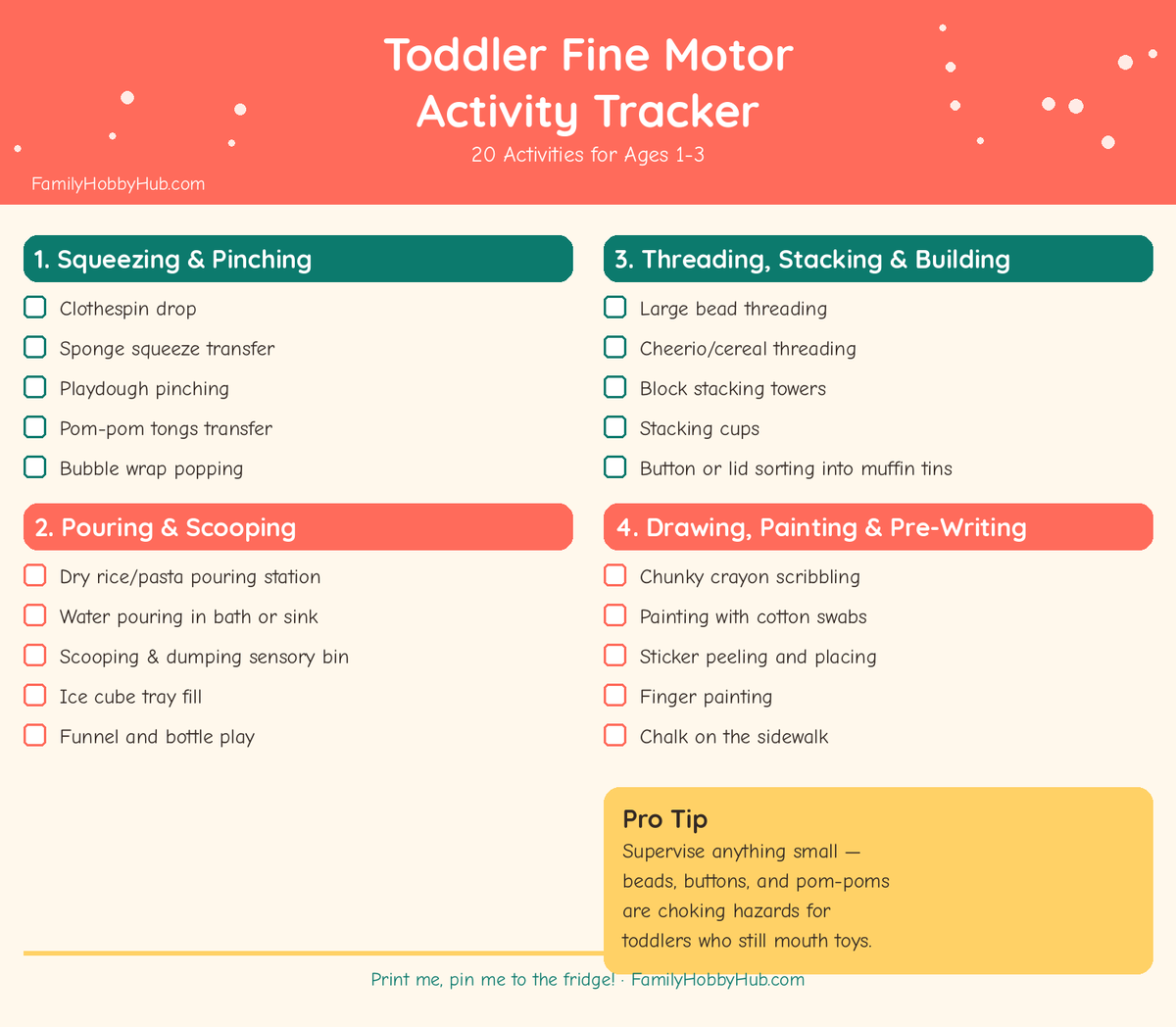
📥 Download the free Toddler Fine Motor Activity Tracker (PDF) Many fine motor skill activities for toddlers double as calm, focused independent play.
Tips for Fine Motor Play with Toddlers
- Supervise anything small. Beads, buttons, and pom-poms are choking hazards for toddlers who still mouth objects — stay within arm’s reach for every activity on this list.
- Follow their interest, not a schedule. A toddler who wants to pour water for 20 minutes straight is doing exactly the kind of repetition their hands need — let them.
- Expect mess, not mastery. The goal is practice, not a perfect result — a lopsided block tower and spilled rice are both signs the activity worked.
- Rotate the basket weekly. Keeping only 4–5 activities available at a time (and swapping them out) keeps interest higher than dumping everything out at once.
- Narrate what their hands are doing. Simple language like “you’re squeezing” or “you’re pouring” builds vocabulary alongside the physical skill.
Fine Motor Skill Activities for Toddlers: What “Ready” Looks Like
Not every toddler is ready for the same fine motor skill activities for toddlers at the same time, and that’s completely normal. A 12-month-old is still mostly working on a whole-hand grasp, while a 3-year-old is closer to holding a crayon with a proper tripod grip.
Watching how your child naturally reaches for objects tells you a lot about which fine motor skill activities for toddlers to reach for next — a child still raking objects toward themselves with their whole hand benefits most from simple squeezing and dumping tasks, while a child who’s already pinching small objects between thumb and forefinger is ready for threading, stacking, and early drawing. The best fine motor skill activities for toddlers require almost no cleanup.
There’s no need to rush through a checklist in order. Toddlers move back and forth between skill levels depending on the day, their mood, and how tired they are, so treat this list of fine motor skill activities for toddlers as a rotating menu rather than a strict curriculum. Offering a slightly-too-easy option alongside a slightly-too-hard one lets your child self-select the right challenge level, which usually works better than an adult guessing correctly every time. Choosing fine motor skill activities for toddlers based on their current grasp keeps the challenge level just right.
| Rough Age | Typical Grasp | Best Fine Motor Skill Activities for Toddlers |
|---|---|---|
| 12-18 months | Whole-hand / raking grasp | Squeezing, dumping, simple stacking |
| 18-24 months | Emerging pincer grasp | Pouring, scooping, large threading |
| 2-3 years | Refined pincer grasp | Small threading, drawing, pre-writing |
How to Turn Everyday Moments into Fine Motor Practice
You don’t need a dedicated activity time slot for every one of these fine motor skill activities for toddlers to be useful — plenty of ordinary household moments already build the same skills. Letting a toddler help peel a banana, unscrew a (child-safe, empty) bottle cap, or use a clothespin to hang up a small towel all count as genuine fine motor skill activities for toddlers, even though they don’t look like a planned activity.
Cooking together is an especially rich source: stirring, pouring, and tearing lettuce all use the same small hand muscles as the more structured activities on this list. These fine motor skill activities for toddlers work well with things you already have at home.
Getting dressed is another daily opportunity hiding in plain sight. Encouraging a toddler to attempt buttons, zippers, or pulling on socks — even if you end up finishing the job — builds the same coordination as any of the fine motor skill activities for toddlers listed above, just spread out across the whole day instead of concentrated into one sitting. The cumulative effect of these small, repeated moments often matters more than any single structured activity, so don’t feel like you’re falling behind if a busy day means skipping the planned activity entirely.
Rotating fine motor skill activities for toddlers every week or two keeps them from getting boring.
Mistakes to Avoid with Fine Motor Skill Activities for Toddlers
A common mistake with fine motor skill activities for toddlers is jumping straight to activities meant for preschoolers — small beads, thin markers, tiny puzzle pieces — before a toddler’s hand strength and grasp are ready. This usually leads to frustration rather than skill-building, and a child who’s repeatedly handed something too hard may start avoiding fine motor play altogether.
Starting a size or two larger than you think you need, and sizing down only once your toddler is breezing through the current level, keeps fine motor skill activities for toddlers feeling like a fun challenge instead of a frustrating one.
Another mistake is stepping in too quickly to help. It’s tempting to finish a task for a struggling toddler, but the productive struggle — the fumbling, the dropped pieces, the third attempt at threading a bead — is exactly where the muscle and coordination development happens. Give fine motor skill activities for toddlers a little more silent space than feels natural before offering help, and let your child ask for it rather than assuming they need it.
Finally, remember that safety always comes first with anything small enough to be a choking hazard — every one of these fine motor skill activities for toddlers should be done under direct supervision for children who still mouth objects, and swapped for larger-sized versions of the same activity when in doubt.
Consistency matters more than intensity when it comes to fine motor skill activities for toddlers. A relaxed ten minutes most days beats one long, forced session once a week — toddlers build coordination through frequent, low-pressure repetition, not through a single marathon practice session. If a particular activity isn’t landing, it’s usually more effective to swap it for a different one on this list than to keep pushing the same one repeatedly.
Simple DIY Fine Motor Skill Activities for Toddlers on a Budget
You don’t need to buy specialty toys to cover most of the fine motor skill activities for toddlers on this list. A muffin tin and a bowl of pom-poms makes a sorting game. An empty tissue box with a slit cut in the top turns into a fabric-pulling activity. A cardboard box with holes poked through it and some pipe cleaners becomes a poking-and-threading station.
Reusing containers you already have on hand — yogurt cups, egg cartons, cereal boxes — keeps a rotating supply of fine motor skill activities for toddlers going without adding to a growing pile of plastic toys.
Clothespins deserve a special mention, since a single bag of them covers an enormous range of fine motor skill activities for toddlers on their own: clipping them to a box edge, sorting them by color, or using them to “pick up” pom-poms all work the same pincer muscles in slightly different ways. Keeping a small, low-cost rotation of household-object activities alongside any purchased toys means you’ll always have a backup option on hand when a toddler loses interest in whatever’s currently out.
When you’re short on time, keep a small “grab and go” bag of two or three favorite fine motor skill activities for toddlers by the door for waiting rooms, car rides, or restaurant tables. A bag of pipe cleaners and pony beads, a travel-size container of playdough, or a small zip pouch of clothespins and a card takes up almost no space but can buy fifteen genuinely calm minutes when you need them most.
Swap the contents every couple of weeks so the bag doesn’t lose its novelty, and treat it as reserved specifically for those higher-stakes waiting moments rather than everyday home use.
Toddler siblings close in age can often share the same fine motor skill activities for toddlers with only small tweaks — a younger toddler gets the larger-piece version of a threading activity while an older sibling handles smaller beads at the same table, so both are engaged without needing two completely separate setups. This kind of shared-table play also has a social bonus: toddlers frequently imitate what an older sibling or friend is doing, which can pull a reluctant toddler into a fine motor skill activities for toddlers session they might have skipped if offered solo.
Just keep a close eye on any small pieces within reach of a younger, more mouthy toddler at the table, and separate the piece sizes if needed.
Frequently Asked Questions
What age should toddlers start fine motor activities?
Fine motor play can start as early as 12 months with simple activities like stacking large blocks or dropping objects into a container, and can be safely scaled up in complexity through age 3 and beyond. Most fine motor skill activities for toddlers only need five to ten minutes to be worthwhile.
How often should toddlers practice fine motor skills?
A little daily practice — even 10-15 minutes woven into normal play — is more effective than occasional long sessions. Most of these activities can simply be left out as open-ended play options. Occupational therapists often recommend fine motor skill activities for toddlers as an easy, low-cost way to build hand strength.
What are signs a toddler needs more fine motor practice?
Difficulty holding utensils or crayons, trouble with buttons or zippers past the age most peers manage them, or strong avoidance of hands-on activities like playdough can be signs to add more low-pressure practice — and to mention it to your pediatrician if you’re concerned. A short daily dose of fine motor skill activities for toddlers adds up over the course of a week.
Are these activities safe for toddlers who still put things in their mouths?
Choose the taste-safe or supervised-only versions accordingly: pouring water, chunky crayons, and finger painting are generally fine unsupervised for a moment, while anything with small beads, buttons, or pom-poms needs an adult within arm’s reach at all times. Many fine motor skill activities for toddlers double as calm, focused independent play.
Final Thoughts
You don’t need a shelf of expensive toys to build strong fine motor skills — just a rotating basket of everyday objects and a little patience for the mess. Print the activity tracker, pick one or two ideas to try this week, and watch how quickly those small hands get steadier. The best fine motor skill activities for toddlers require almost no cleanup.
Pin This for Later!
Save this to your Pinterest board so you can find it again next time you need it.

About the Author: Family Hobby Hub
The Family Hobby Hub team researches and puts together simple, screen-free activity ideas for parents, grandparents, and caregivers — indoor play and sensory activities, backyard and outdoor games, on-the-go entertainment for car rides and waiting rooms, and easy learning and STEM activities for kids of different ages. Every guide is built around things most families already have around the house, takes only a few minutes to set up, and comes with a free printable checklist or activity sheet whenever possible. We are not child development specialists, educators, or licensed childcare professionals, and our activity ideas are general suggestions for family fun rather than professional guidance. Always supervise children during any activity and use your own judgment about what is appropriate for your child's age, interests, and abilities.