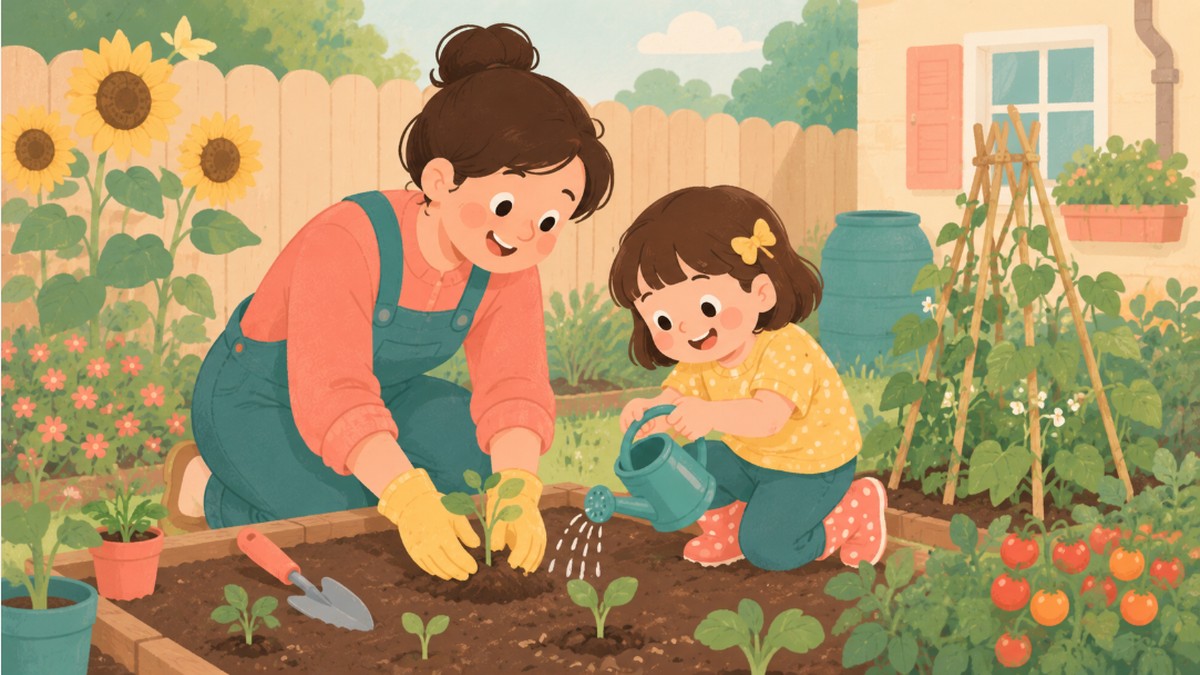
You don’t need a big yard or a green thumb to get kids excited about growing something — a single pot on a windowsill covers most of it. Below are 16 gardening activities for kids that cover planting, observing, harvesting, and a little bit of garden-themed art, organized by type, plus a free printable garden growth journal to track what you plant.
Why Gardening Activities for Kids Are Worth the Dirt Under Their Nails
KidsGardening, a nonprofit that’s supported school and family gardens since 1982, puts it plainly: “a garden is a wonderful place for children to play, learn, and grow.” That’s the whole case for gardening activities for kids in one sentence — a garden bed or even a single pot gives a child a slow-motion science experiment, a patience-building project, and a reason to be outside, all at once, without needing to be framed as a lesson.
The gardening activities for kids below are grouped by type, so you can start with a fast, satisfying win (a bean teepee grows visibly within days) before moving into the slower observation-based projects that reward patience over a full season.
Unlike a lot of kids’ activities, gardening activities for kids don’t wrap up in an afternoon — a seed planted this week is still a story next month. That stretched-out timeline is actually part of the value: kids get regular, low-stakes practice with delayed gratification, checking on something day after day without an immediate payoff every single time.
It also helps to plan gardening activities for kids around the calendar you actually have, rather than waiting for the “perfect” gardening season. A fall bulb-planting afternoon, a spring seed-starting week, and a midsummer harvest all count, and spacing a few different gardening activities for kids across the year keeps the whole project going instead of it being a single spring project that fizzles out by June.
What You’ll Need
A full garden bed isn’t required — a pot and a sunny windowsill cover a lot of this list:
- A few pots or a small garden bed
- Potting soil
- Seeds or seedlings (beans, sunflowers, and herbs are all beginner-friendly)
- A small watering can
- Kid-sized gloves and a hand trowel
- A notebook or the free printable growth journal below
1. Planting & Growing Projects
- Bean teepee. Plant pole beans around a teepee of garden stakes and let them climb into a real, sit-inside hideout over a few weeks — one of the most rewarding gardening activities for kids because the payoff is a literal fort.
- Seed starting in cups. Clear plastic cups let kids watch roots develop underground, not just the sprout above soil.
- Sunflower growing race. Each family member plants one sunflower seed and tracks whose grows tallest — a simple, visible competition that lasts all summer.
- Herb pot on a windowsill. Basil, mint, or parsley in a small pot works even without any outdoor space at all.
2. Garden Science & Observation
- Garden bug hunt. A magnifying glass and a few minutes spent looking under leaves usually turns up ladybugs, worms, or ants worth a closer look.
- Worm bin observation. A small clear bin with soil and a few earthworms lets kids watch how worms move through and aerate soil.
- Growth journal tracking. Measuring and sketching a plant’s progress once a week turns ordinary growth into a real data-collection project — see the free printable below.
- Pollinator watch. Sit quietly near a flowering plant for a few minutes and count how many different bees or butterflies visit.
3. Harvesting & Tasting
- Pick-your-own veggie taste test. Harvesting a cherry tomato or snap pea straight off the plant and tasting it on the spot is often the single most memorable of all gardening activities for kids.
- Build-your-own salad from the garden. Let kids pick whatever’s ready and help assemble a simple salad or veggie plate from what they grew.
- Herb smell-and-guess game. Rub a few different herb leaves and guess which is which by smell alone before checking the plant tag.
- Harvest-day counting. Count and record exactly how many tomatoes, beans, or peas came off the plant that day — a satisfying, numbers-based close to one of the more hands-on gardening activities for kids.
4. Garden Crafts & Decor
- Painted plant markers. Painted rocks or popsicle sticks labeling each plant give kids a small art project that also helps them track what’s growing where.
- Rock garden border. Collecting and arranging rocks to edge a garden bed is a simple, satisfying task for younger kids who aren’t ready for planting yet.
- Pressed flower art. Pressing garden flowers between heavy books for a week or two produces material for cards or bookmarks later.
- Scarecrow building. An afternoon project using old clothes and stuffing that doubles as both a craft and a (mostly decorative) garden helper.
Free Printable: Kids Garden Growth Journal
To make it easy to track what you’ve planted and how it’s growing, we made a free printable garden growth journal covering all 16 gardening activities for kids listed above, plus a simple weekly measurement chart. Check off ideas as you try them and jot down what sprouted first.
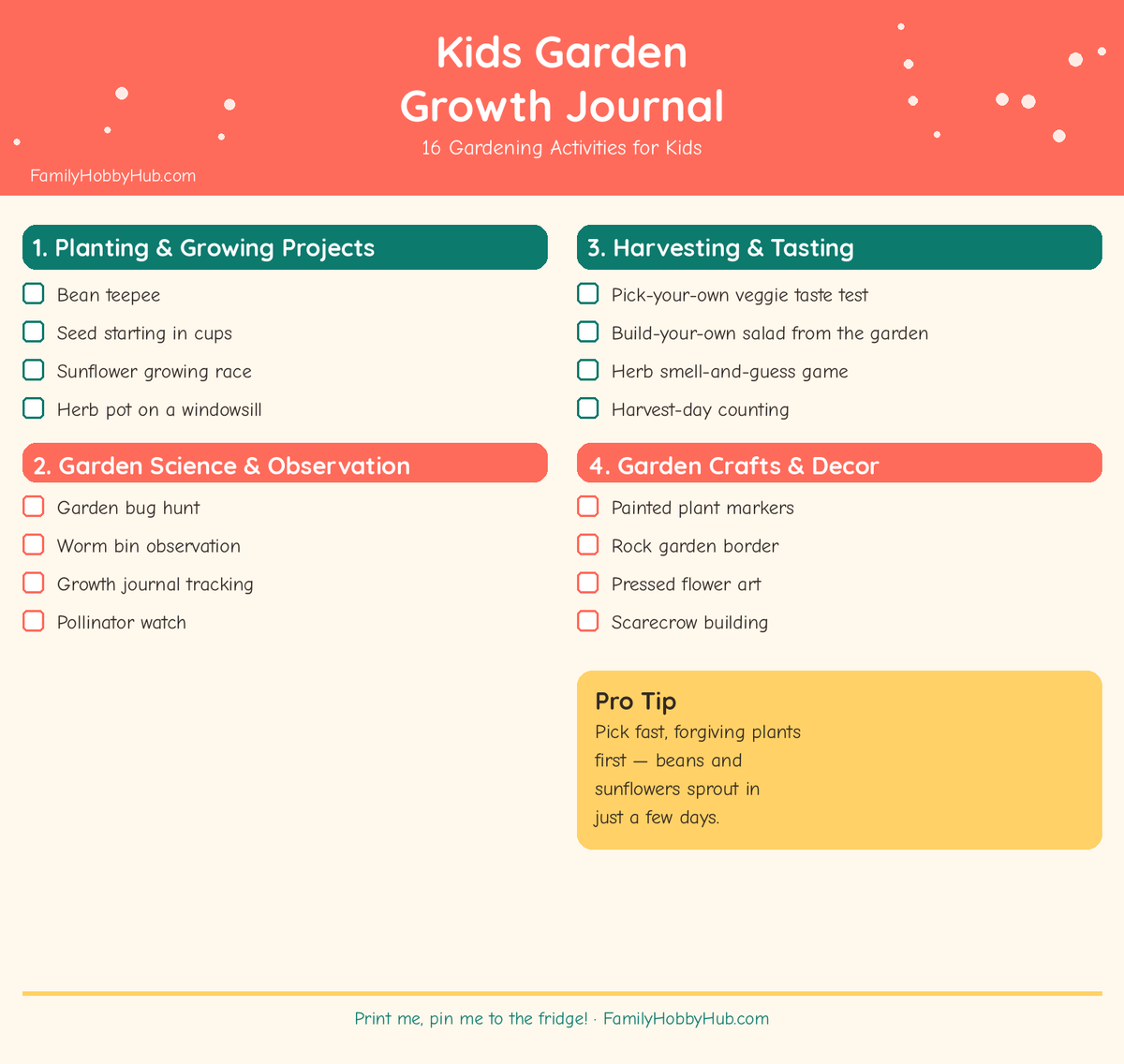
📥 Download the free Kids Garden Growth Journal (PDF)
Budget-Friendly Tips
Gardening activities for kids can start for just the cost of a seed packet — a few dollars covers enough bean or sunflower seeds for an entire family. Reuse containers you already have (yogurt cups, an old bucket with drainage holes poked in the bottom) instead of buying pots, and ask neighbors or a local community garden for seedling cuttings, which are often free or nearly free. Save an actual raised garden bed for later, once you know your kids are genuinely engaged with a smaller-scale version first.
Tips for a Group or Classroom Garden
Gardening activities for kids scale up naturally for a classroom, scout troop, or group of neighborhood kids sharing one garden bed. Assign each child their own labeled section or pot so everyone has a specific plant to check on and feel ownership over, rather than one shared bed nobody feels responsible for. For the growth journal and bug hunt activities, rotating a “garden helper of the week” job keeps a larger group engaged without everyone needing to do the same task on the same day.
A shared garden also gives a bigger group of kids a reason to compare notes — whose sunflower is tallest this week, whose bean teepee sprouted first — which tends to keep motivation up longer than any single child tracking their own plant alone. Just make sure the labeled sections stay clearly marked, since a mix-up over whose plant is whose is the most common source of squabbling in a group version of these gardening activities for kids.
| Age Range | Best Gardening Activities for Kids | Adult Involvement Needed |
|---|---|---|
| 2-4 years | Rock garden border, painted plant markers, watering | High — adult manages tools and planting |
| 5-8 years | Bean teepee, seed starting in cups, growth journal | Medium — adult supervises planting depth and watering schedule |
| 9-12 years | Worm bin observation, pollinator watch, full bed planning | Low — kids manage most of the season independently |
As a rough guide, younger kids get the most out of gardening activities for kids with an immediate sensory payoff — dirt to pat down, a rock to place, a watering can to fill — while older kids start to enjoy the slower, more analytical gardening activities for kids like tracking growth data or planning what goes where in a full bed next season.
Looking for more outdoor ways to fill the season? See our backyard camping ideas for a screen-free evening once the garden’s planted, or browse our fun fall activities for kids for what to do once the harvest season winds down.
Tips for Gardening with Kids
- Pick fast, forgiving plants first. Beans, sunflowers, and radishes sprout quickly and tolerate mistakes — save slower or fussier plants for after a first successful season of gardening activities for kids.
- Let them get dirty. Digging, patting down soil, and handling worms barehanded (with a chance to wash up after) is where a lot of the actual engagement happens.
- Expect some plants not to make it. A seed that doesn’t sprout is a real, low-stakes lesson about variables like sunlight and watering — not a failure to smooth over.
- Keep tools kid-sized. A trowel and gloves sized for small hands make gardening activities for kids feel like their own project instead of borrowing adult equipment.
- Celebrate the harvest, however small. Even a single cherry tomato is worth a genuine moment of celebration the first time.
Frequently Asked Questions
What age can kids start gardening activities?
Even toddlers can join in with simple gardening activities for kids like watering, patting down soil, or arranging rocks, while school-age kids can usually manage planting and tracking a full growth journal on their own.
Do we need a yard to do any of this?
No — several of these gardening activities for kids, like the herb pot and seed starting in cups, work entirely on a sunny windowsill or balcony with no yard required.
What’s the easiest first plant to grow with kids?
Pole beans and sunflowers are both fast, forgiving, and visually dramatic — ideal gardening activities for kids to start with since results show up within days rather than weeks.
What if something in the garden dies or doesn’t grow?
Treat it as a normal part of gardening activities for kids rather than a setback — talk through what might have happened (too much water, not enough sun) and try again with an adjustment.
How much time do gardening activities for kids take each week?
Most of the ongoing gardening activities for kids on this list — watering, a quick growth journal check, a short bug hunt — take five to ten minutes a few times a week. The bigger time investments (planting day, harvest day) happen only a few times across a whole season.
Final Thoughts
A garden doesn’t need to be big to be worthwhile — one pot, one seed, and a little patience cover most of what these gardening activities for kids need to get started. Print the growth journal, pick one fast-growing plant this week, and let the season’s slow progress become a small, shared project.

About the Author: Family Hobby Hub
The Family Hobby Hub team researches and puts together simple, screen-free activity ideas for parents, grandparents, and caregivers — indoor play and sensory activities, backyard and outdoor games, on-the-go entertainment for car rides and waiting rooms, and easy learning and STEM activities for kids of different ages. Every guide is built around things most families already have around the house, takes only a few minutes to set up, and comes with a free printable checklist or activity sheet whenever possible. We are not child development specialists, educators, or licensed childcare professionals, and our activity ideas are general suggestions for family fun rather than professional guidance. Always supervise children during any activity and use your own judgment about what is appropriate for your child's age, interests, and abilities.