For general safety guidance when trying experiments with kids at home, see the U.S. Consumer Product Safety Commission, and check out our more hands-on activity ideas for kids.
Kids don’t need a lab coat or a chemistry set to start acting like little scientists — most of the best first experiments use things already in your pantry. Below are 15 simple science experiments kids can do at home, organized by type, plus a free printable experiment tracker to log what you’ve tried and what happened. These simple science experiments kids can do at home use supplies from a typical kitchen.
Why Hands-On Science Matters So Early
Early-childhood science educators point out that curiosity is already built in — kids don’t need to be taught to wonder how things work. NAEYC’s own guidance on early science learning notes that “children are born curious and compelled to investigate everything” around them, and that the adult’s job is less about explaining answers and more about setting up simple, safe opportunities to explore. Every experiment below is designed around that idea: let your child predict, observe, and ask “why” before you jump in with the answer.
Rotating simple science experiments kids can do at home every week or two keeps curiosity high.
The activities are grouped by type so you can match one to whatever’s already in your kitchen or recycling bin. Most simple science experiments kids can do at home take fifteen minutes or less.
What You’ll Need
Nearly everything below uses common household items: Teachers often recommend simple science experiments kids can do at home as a way to build early scientific thinking.
- Baking soda and vinegar
- Food coloring
- Clear cups or jars
- Balloons
- Dish soap
- A few coins, paper clips, and small toys
- A magnifying glass (optional but fun)
1. Kitchen Chemistry
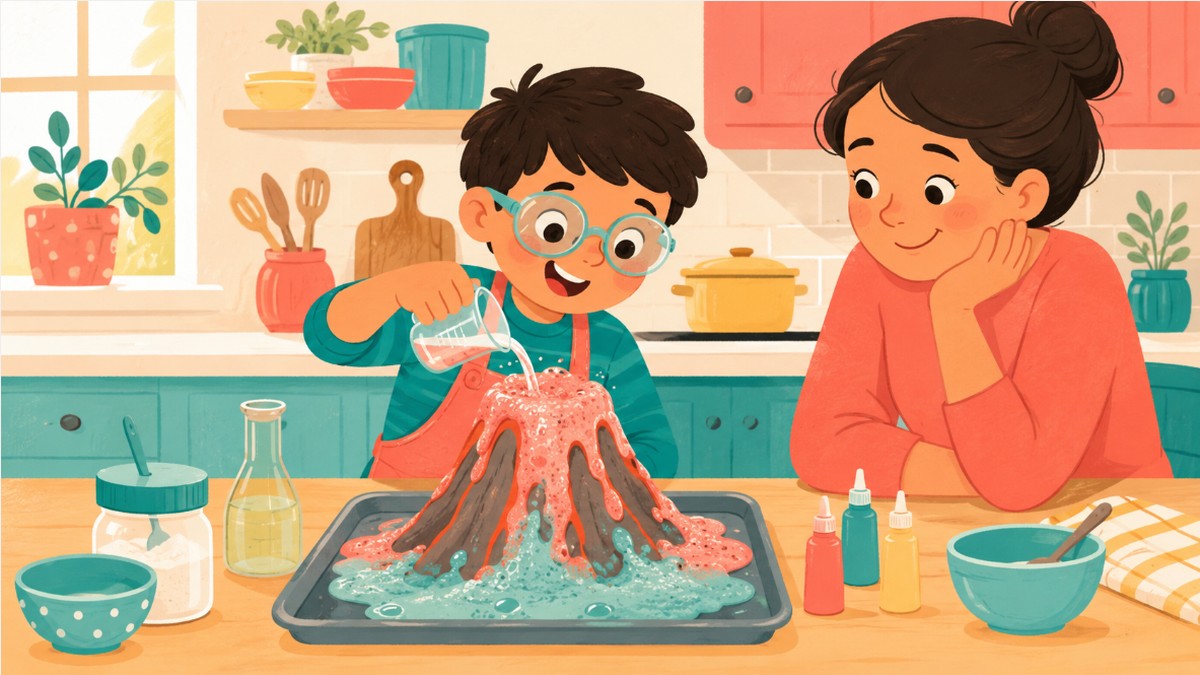
- Baking soda volcano. A classic for a reason — baking soda and vinegar in a cup produce a fizzy, foamy reaction kids never seem to tire of.
- Milk and dish soap color explosion. A few drops of food coloring in milk, then a drop of dish soap, sends the colors swirling in a genuinely surprising way.
- Balloon inflation reaction. Baking soda and vinegar sealed in a bottle with a balloon on top inflates the balloon using the gas from the reaction.
- Invisible ink with lemon juice. Lemon juice “ink” written on paper stays invisible until held near a warm lightbulb, when it slowly appears.
2. Physics & Motion
- Egg drop challenge. Build a simple padded container from household materials and test whether it protects a raw egg dropped from a set height.
- Balloon rocket. Thread a straw onto a string, tape a balloon to it, and let the air escaping launch it along the string like a rocket.
- Paper airplane distance test. Fold a few different paper airplane designs and test which flies farthest — a simple, repeatable experiment in variables.
- Marble ramp race. Build ramps from cardboard tubes at different angles and test which sends a marble farthest or fastest.
3. Nature & Biology
- Bean sprout in a bag. A damp paper towel and a bean seed in a zip-top bag taped to a window let kids watch roots and shoots emerge day by day.
- Celery color-changing experiment. Stand celery stalks in cups of colored water and watch the color travel up through the leaves over a day or two.
- Backyard bug hunt with a magnifying glass. A simple magnifying glass and a notebook turn a normal backyard walk into an observation project.
- Melting ice race. Place ice cubes in different spots (sun, shade, indoors) and predict which will melt first.
4. Sensory Science
- Oobleck (cornstarch and water). This classic non-Newtonian mixture acts like a liquid when still and a solid when squeezed — endlessly fascinating to test with their hands.
- Static electricity balloon. Rub a balloon on hair or a wool sweater and see what small items (paper bits, hair) it can pick up.
- Density tower. Layer honey, dish soap, water, and oil in a clear cup to see them settle into visible layers by density.
Free Printable: Home Science Experiment Tracker
To make it easy to keep track of what you’ve tried (and what your child predicted versus what actually happened), we made a free printable experiment tracker with all 15 ideas grouped exactly as above. Check one off after you try it, and jot down what your little scientist noticed. A short weekly dose of simple science experiments kids can do at home adds up over a school year.
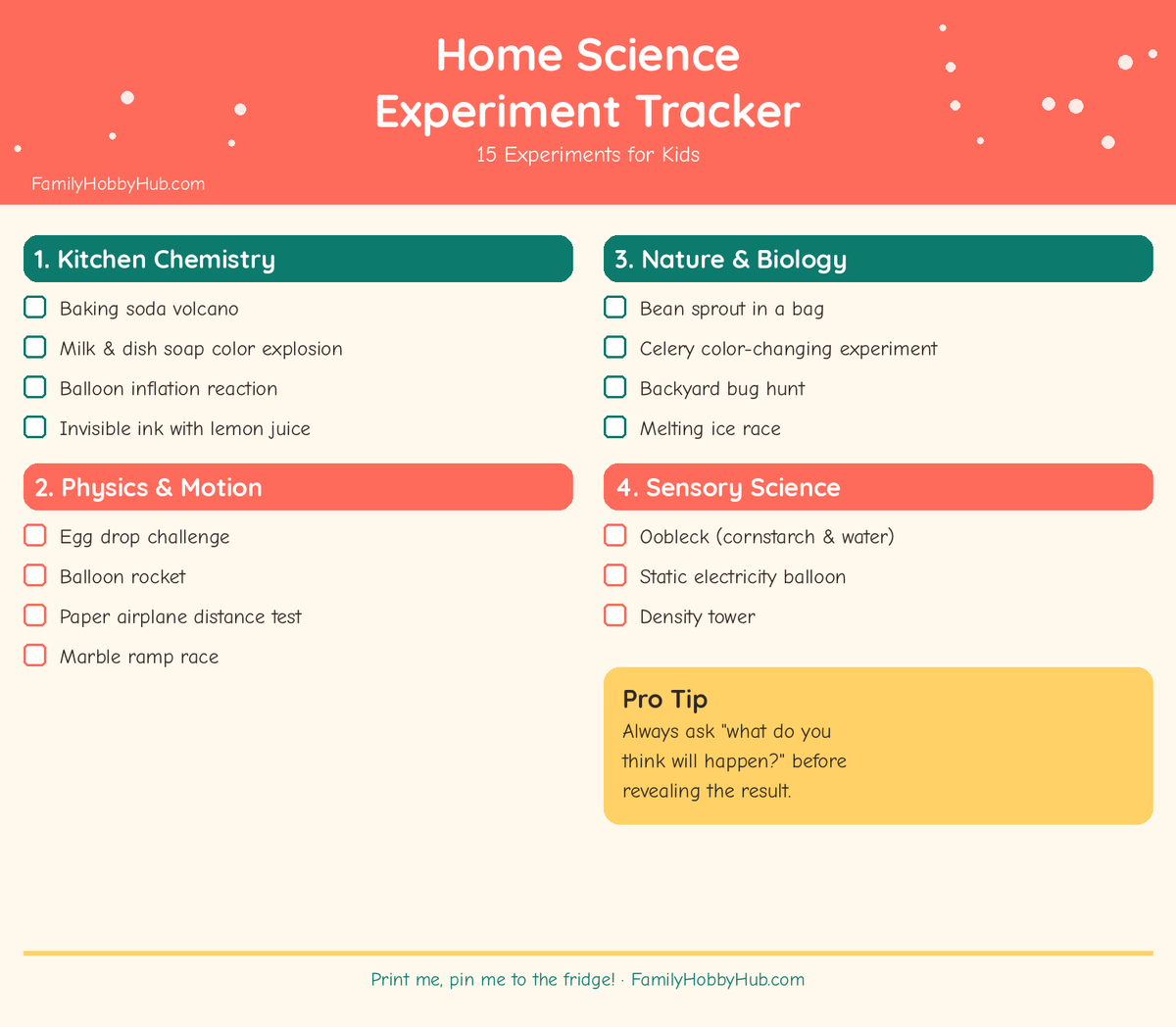
📥 Download the free Home Science Experiment Tracker (PDF) Many simple science experiments kids can do at home double as an easy weekend activity.
Tips for Doing Science Experiments with Kids
- Ask for a prediction first. Before revealing the result, ask “what do you think will happen?” — this is the single easiest way to make any experiment more scientific.
- Let them do the messy part. Measuring, pouring, and mixing are where the real learning happens — resist doing it for them even if it’s slower or messier.
- It’s okay if the “experiment” doesn’t work. An egg that cracks or a rocket that doesn’t launch is still a valid result — ask what they’d change next time.
- Keep safety in view. Supervise anything with small parts, hot water, or open flames, and keep household chemicals limited to the kid-safe pairings listed here (never mix bleach with anything).
- Repeat favorites. Doing the same experiment again with a small change (more vinegar, a steeper ramp) teaches variables far better than always trying something brand new.
Simple Science Experiments Kids Can Do at Home by Age
Not every one of these simple science experiments kids can do at home suits every age the same way. Preschoolers get the most out of experiments with an immediate, obvious result — a color-changing reaction, a fizzy volcano, something that happens right away and holds attention without a long wait.
Elementary-age kids can handle simple science experiments kids can do at home that involve a bit more waiting or measuring, like tracking a plant’s growth over a week or testing which materials float and sink through several rounds. Older elementary kids can start layering in real hypothesis-and-prediction thinking before each experiment, turning even the simplest kitchen chemistry into a genuine practice of the scientific method. The best simple science experiments kids can do at home need very little adult prep.
| Age Range | Best Simple Science Experiments Kids Can Do at Home | |
|---|---|---|
| 3-5 years | Immediate-result reactions, sensory science | |
| 6-8 years | Physics and motion, short-term nature observation | |
| 9-12 years | Multi-day experiments, hypothesis-driven testing |
Turning Simple Science Experiments Kids Can Do at Home into a Habit
The families who stick with simple science experiments kids can do at home longest usually treat it as a loose weekly rhythm rather than a one-off special occasion. Setting aside even fifteen minutes on a regular day — a “science Saturday” or a rainy-day standby — keeps a rotating set of simple science experiments kids can do at home from feeling like a big production every single time.
Keeping a small bin of reusable supplies (baking soda, vinegar, food coloring, a few containers) ready to go removes the single biggest barrier: last-minute scrambling for ingredients. Choosing simple science experiments kids can do at home based on age keeps engagement high.
Letting kids choose which simple science experiments kids can do at home to try next, from a short list of two or three options, builds ownership and curiosity that a fully adult-planned schedule often misses. A child who picked the volcano experiment themselves tends to engage far more deeply with the “why” behind it than one who was simply handed a worksheet to follow. These simple science experiments kids can do at home use supplies from a typical kitchen.
Common Mistakes with Simple Science Experiments Kids Can Do at Home
A frequent mistake is treating simple science experiments kids can do at home as something that needs to look like a real laboratory to count. A messy kitchen counter with household items works just as well as an expensive science kit, and in some ways better — kids learn that real experimentation happens with everyday materials, not just special equipment bought for the occasion. Skipping a purchase because you don’t have a “proper” kit shouldn’t stop simple science experiments kids can do at home from happening at all.
Another mistake is rushing straight to the result without pausing to predict what will happen first. The single most valuable habit to build into simple science experiments kids can do at home is a quick “what do you think will happen?” question before starting — this turns a passive demonstration into an active hypothesis-testing exercise, which is the actual core of scientific thinking, regardless of how simple the experiment itself is.
Finally, don’t treat an experiment that “doesn’t work” as a failure. Some of the richest learning in simple science experiments kids can do at home comes from troubleshooting why a reaction fizzled or a structure collapsed — that’s exactly the kind of iterative problem-solving real scientists do constantly, and modeling curiosity about the unexpected result teaches more than a perfectly executed experiment would.
Simple Science Experiments Kids Can Do at Home on a Budget
Most simple science experiments kids can do at home cost next to nothing. Baking soda, vinegar, food coloring, and dish soap — staples already in most kitchens — cover a huge share of the classic reactions on this list. Plastic cups, a few rubber bands, and some paper make up the entire supply list for several of the physics-based options. Even the nature and biology experiments mostly rely on things found in a backyard or picked up on a walk, at no cost at all.
Reusing containers instead of buying specialty labware keeps simple science experiments kids can do at home essentially free. An empty water bottle, a mason jar, or a yogurt cup all substitute perfectly well for beakers or specimen containers, and using “real” household items actually reinforces the useful lesson that science happens with ordinary tools, not just specialized ones.
Simple Science Experiments Kids Can Do at Home for Siblings of Different Ages
Mixed-age groups make simple science experiments kids can do at home a little trickier to plan, but the fix is usually assigning roles instead of identical tasks. A younger sibling can measure and pour ingredients while an older one reads the steps aloud and records what happens — everyone is involved in the same simple science experiments kids can do at home, just at a level that matches their actual skills.
Letting the older kid “teach” the younger one what’s happening also reinforces their own understanding, since explaining a concept out loud is one of the most effective ways to actually learn it. Many families find that simple science experiments kids can do at home work best as a shared project rather than a solo one, precisely because the explaining-and-showing dynamic between siblings does half the teaching for you.
If the age gap is wide enough that the youngest can’t safely handle any part of the experiment, give them a dedicated “observer” job instead — predicting outcomes out loud, or drawing a picture of what happened afterward. That keeps simple science experiments kids can do at home inclusive without forcing an unsafe task on a child who isn’t ready for it.
How to Store Supplies for Simple Science Experiments Kids Can Do at Home
A dedicated bin or drawer makes simple science experiments kids can do at home much easier to start on a whim, since the barrier to “let’s do a quick experiment” drops to almost nothing when the supplies are already gathered in one place. Clear plastic bins with a printed label work well, and sorting them by type — food-based, mixing, physical/gravity-based — makes it faster to grab exactly what a given experiment calls for.
Keeping a small supply of the recurring basics (baking soda, vinegar, food coloring, balloons, straws) restocked means simple science experiments kids can do at home can happen spontaneously on a slow afternoon instead of only after a special shopping trip. A short running list on the fridge or in your phone, updated whenever you notice a supply running low, keeps that bin ready without much ongoing effort.
Simple Science Experiments Kids Can Do at Home Without Buying a Kit
You don’t need a store-bought science kit to run simple science experiments kids can do at home — most of the classics (baking soda volcanoes, oil-and-water density jars, rubber-egg experiments in vinegar, static electricity with a balloon) use ingredients already in a typical kitchen or bathroom cabinet. Skipping the kit also means skipping the pressure to follow a printed instruction card exactly, which leaves more room for a kid to ask “what if we tried it with something else instead?” — often the most valuable part of simple science experiments kids can do at home.
Kits are convenient and can be a nice gift, but treating them as the only way to do simple science experiments kids can do at home sets an unnecessarily high bar for a rainy Tuesday afternoon. A pantry, a recycling bin, and fifteen free minutes are usually enough.
A quick note on cleanup: keeping a designated “science towel” and a tray to contain spills means simple science experiments kids can do at home stay low-stress even when a reaction fizzes over or a mixture spills. Wiping down as you go, rather than saving it all for the end, also keeps the momentum going into the next idea on the list.
Frequently Asked Questions
What age can kids start doing simple science experiments?
Preschoolers can participate in simplified versions of most of these (with an adult handling any pouring of vinegar or hot water), while elementary-age kids can usually manage most of the setup themselves. Rotating simple science experiments kids can do at home every week or two keeps curiosity high.
Do I need to buy a science kit to do experiments at home?
No — every experiment on this list uses ordinary pantry and household items, no specialized kit required. Most simple science experiments kids can do at home take fifteen minutes or less.
What’s the easiest experiment to start with if we’ve never done one before?
The baking soda volcano and the milk and dish soap color explosion are both fast, low-prep, and reliably produce an obvious, exciting result on the first try. Teachers often recommend simple science experiments kids can do at home as a way to build early scientific thinking.
How do I make these more “educational” instead of just fun?
Adding a simple prediction step before each experiment, and asking your child to describe what happened afterward, turns the same activity into real scientific thinking without changing the setup at all. A short weekly dose of simple science experiments kids can do at home adds up over a school year.
Final Thoughts
You don’t need a lab or a science degree to raise a curious kid — a box of baking soda and a few clear cups cover most of what these experiments need. Print the tracker, pick one to try this week, and let their questions lead the way. Many simple science experiments kids can do at home double as an easy weekend activity.
Pin This for Later!
Save this to your Pinterest board so you can find it again next time you need it.


About the Author: Family Hobby Hub
The Family Hobby Hub team researches and puts together simple, screen-free activity ideas for parents, grandparents, and caregivers — indoor play and sensory activities, backyard and outdoor games, on-the-go entertainment for car rides and waiting rooms, and easy learning and STEM activities for kids of different ages. Every guide is built around things most families already have around the house, takes only a few minutes to set up, and comes with a free printable checklist or activity sheet whenever possible. We are not child development specialists, educators, or licensed childcare professionals, and our activity ideas are general suggestions for family fun rather than professional guidance. Always supervise children during any activity and use your own judgment about what is appropriate for your child's age, interests, and abilities.