
For more on hands-on science learning, see NASA’s STEM engagement resources, and browse more science experiments for kids on Family Hobby Hub.
You don’t need a lab coat or a science degree to turn an ordinary afternoon into real hands-on learning — a box of baking soda, a rubber band, or a handful of toothpicks gets you most of the way there. Below are 15 easy STEM activities for kids ages 5-10, organized by subject area, plus a free printable STEM activity checklist to help you plan the week ahead.
These easy STEM activities for kids use supplies most families already have in a kitchen drawer.
Why Easy STEM Activities Matter at This Age
Ages 5-10 are exactly when kids start asking “why” and “how” about everything around them, and easy STEM activities for kids channel that curiosity into something more durable than a quick answer. NASA’s own STEM engagement programs emphasize hands-on exploration over memorized facts, on the theory that a kid who builds a wobbly tower and watches it fall learns more about structural engineering than one who reads about it. Rotating easy STEM activities for kids every week or two keeps that hands-on curiosity from fading into passive screen time instead.
The “failure” built into most STEM activities is actually the point. A bridge that collapses or a rocket that doesn’t fly teaches iteration and problem-solving in a low-stakes way that a worksheet never quite manages. Most easy STEM activities for kids take 20 minutes or less to set up and try.
What You’ll Need
Almost every activity below uses ordinary household or kitchen items. A small supply box covers nearly everything: Teachers often recommend easy STEM activities for kids as a way to reinforce classroom science at home.
- Baking soda and vinegar
- Toothpicks and mini marshmallows or dried peas
- Rubber bands, paper, and tape
- A few plastic cups and a small ramp or board
- Balloons
- Cornstarch (for oobleck)
1. Simple Chemistry & Reactions
Baking soda volcano. A cup of baking soda, a splash of dish soap, and vinegar poured in fast makes a foamy “eruption” that never gets old, and it’s a genuine intro to acid-base reactions.
Oobleck. Mixing cornstarch and water at roughly a 2:1 ratio makes a substance that acts solid under pressure and liquid when still — a hands-on look at non-Newtonian fluids that kids can squish for as long as they want.
Invisible ink. Lemon juice “written” with a cotton swab dries invisible, then reveals itself under gentle heat from a lamp — an easy chemistry activity that doubles as a fun secret-message game.
Color-changing milk. A few drops of food coloring in milk, then a drop of dish soap, sends colors swirling as the soap breaks the milk’s fat molecules apart — dramatic and genuinely science-based.
2. Engineering & Building
Toothpick and marshmallow towers. Building the tallest freestanding structure from toothpicks and mini marshmallows (or dried peas) teaches triangular bracing and load distribution through trial and error.
Paper bridge challenge. Folding a single sheet of paper into a bridge that spans two stacked books and holds the most pennies introduces basic structural engineering concepts.
Egg drop. Building a padded container from straws, cotton balls, or newspaper that protects a raw egg dropped from a set height is a classic engineering challenge with a satisfying (or messy) result.
Marble run from cardboard tubes. Taping paper towel tubes to a wall at different angles to guide a marble to the floor combines engineering with basic physics of motion.
3. Physics & Motion
Balloon rocket. Threading a straw onto a string, taping a balloon to it, and letting the air propel it across the room is a simple, visual demonstration of Newton’s third law.
Rubber band cars. A small cardboard car powered by a wound rubber band axle teaches stored energy and how it converts into motion.
Paper airplane distance test. Folding a few different paper airplane designs and testing which flies farthest introduces basic aerodynamics through direct comparison.
4. Math & Logic Games
Tangram puzzles. A set of seven simple shapes rearranged into pictures builds spatial reasoning — free printable tangram sets work just as well as store-bought sets.
Pattern block challenges. Continuing or predicting a repeating pattern with blocks, beads, or even cereal builds early algebraic thinking well before kids see an actual equation.
Estimation jar. Filling a clear jar with a countable item (buttons, dried beans) and guessing the total before counting together practices estimation and number sense in under five minutes.
Shape scavenger hunt. Finding real-world objects that match geometric shapes (a cone-shaped cup, a cylindrical can) connects abstract math vocabulary to everyday objects.
Free Printable: Easy STEM Activities Checklist
To make it easy to rotate through all 15 ideas without repeating the same activity twice, we made a free printable STEM activity checklist with every idea grouped exactly as above. Check one off as your child tries it, or use it to plan a new experiment each week. A short weekly dose of easy STEM activities for kids adds up to real scientific thinking over a school year.
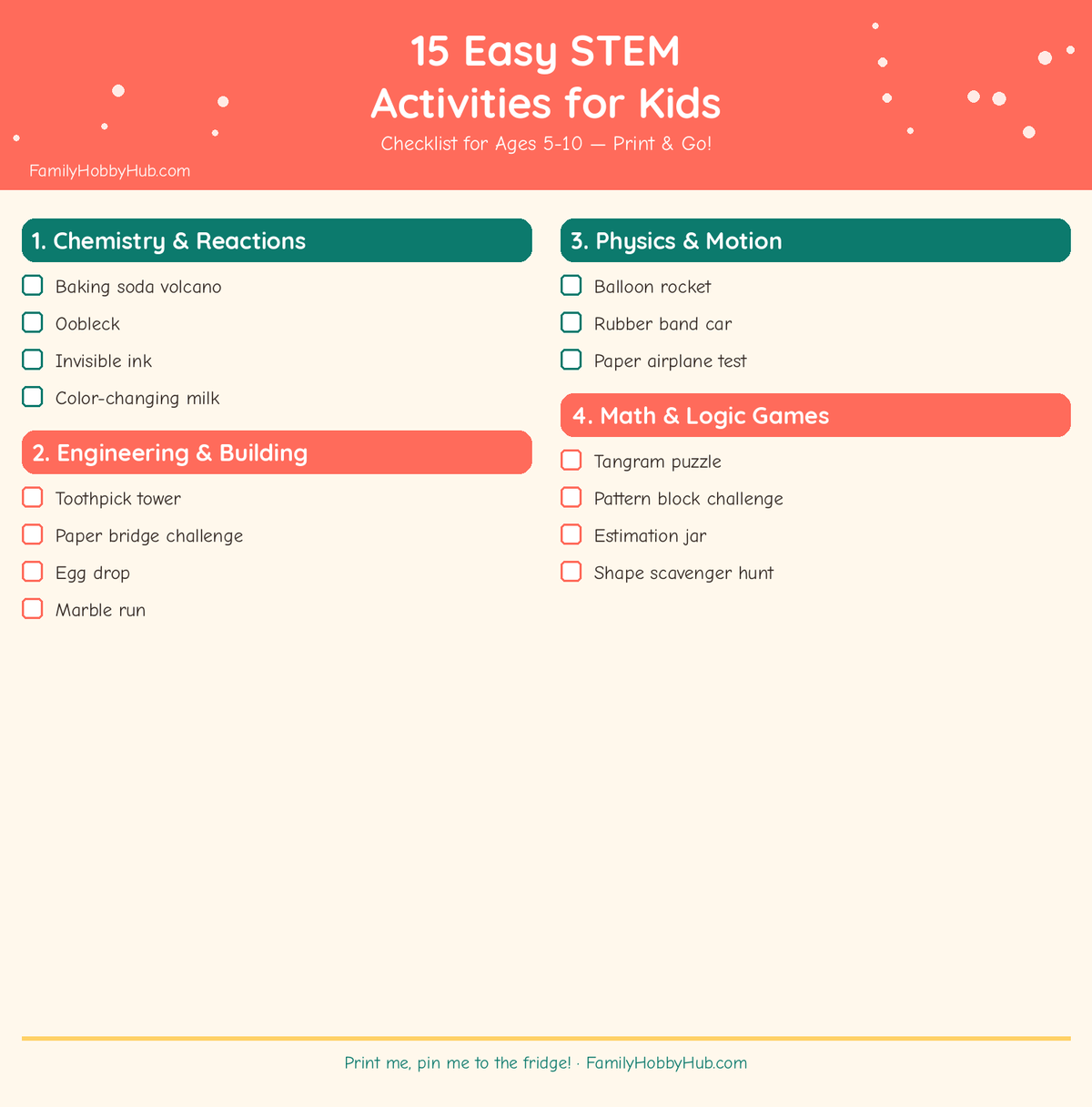
Download the free Easy STEM Activities Checklist (PDF) Many easy STEM activities for kids double as a rainy-day alternative to screen time.
Tips for Easy STEM Activities with Kids
- Let them predict first. Asking “what do you think will happen?” before starting turns any activity into a genuine hypothesis-and-test exercise.
- Expect (and welcome) failure. A collapsed tower or an egg that cracks isn’t a failed activity — it’s the most valuable part of the learning.
- Keep a simple science journal. A notebook where kids draw or write what happened builds observation skills alongside the activity itself.
- Repeat with variables changed. Trying the egg drop again with a different padding material, or the paper airplane test with a new fold, teaches that science is iterative.
- Don’t rush to the “right” answer. Easy STEM activities for kids work best when the process matters more than getting a textbook-perfect result.
Easy STEM Activities for Kids: What the Research Says
Hands-on STEM learning at ages 5-10 lines up with a well-documented window in cognitive development when kids are building the foundations of logical and spatial reasoning. NASA’s STEM engagement framework and similar programs from science museums consistently emphasize inquiry-based learning — letting a child ask a question and test it themselves — over lecture-style instruction at this age. Easy STEM activities for kids give that inquiry-based approach a low-cost, low-pressure home version.
What makes easy STEM activities for kids particularly effective is the immediate feedback loop. A tower either stands or falls, a rocket either flies or doesn’t — there’s no ambiguity about the result, which makes it easy for a child to connect cause and effect on their own rather than being told the answer. The best easy STEM activities for kids need almost no adult explanation to make sense.
| STEM Area | Example Activity | Skill Built |
|---|---|---|
| Chemistry | Baking soda volcano, oobleck | Cause and effect, states of matter |
| Engineering | Toothpick towers, egg drop | Structural reasoning, iteration |
| Physics | Balloon rockets, rubber band cars | Motion, stored energy |
| Math & Logic | Tangrams, estimation jar | Spatial reasoning, number sense |
Turning Everyday Moments into Easy STEM Activities
You don’t need a dedicated “science time” for easy STEM activities for kids to happen — plenty of ordinary moments already double as science lessons. Cooking introduces measuring and basic chemistry (why does bread dough rise?), a car ride is a natural setting for counting games or spotting shapes out the window, and even folding laundry into matching pairs practices basic sorting and categorization. These easy STEM activities for kids work well with things you already have at home.
Grocery shopping can become one of the easiest easy STEM activities for kids of the week with almost no extra effort — comparing prices per unit, estimating how many items fit in the cart, or predicting which grocery bag will feel heavier all sneak in real math practice during a task you’re doing anyway.
Common Mistakes with Easy STEM Activities
A frequent mistake with easy STEM activities for kids is stepping in too early to fix or explain something the child could figure out with a little more time. Watching a tower wobble and adjusting the design is the actual learning moment — jumping in to rebuild it for them skips the part that matters most.
Another common mistake is treating a “failed” experiment as the end of the activity rather than the start of the next question. If the paper airplane crashes immediately, asking “what should we change?” turns a flop into round two rather than a disappointment. Easy STEM activities for kids lose much of their value when the process stops at the first unsuccessful attempt.
Finally, don’t over-explain the science before letting kids try it themselves — telling a child exactly why the volcano fizzes before they’ve seen it happen removes the discovery that makes easy STEM activities for kids memorable in the first place.
Easy STEM Activities for Kids on a Budget
Most easy STEM activities for kids cost next to nothing. Baking soda, vinegar, cornstarch, and food coloring are pantry staples that cover several activities on this list alone. Toothpicks, rubber bands, paper, and cardboard tubes saved from the recycling bin round out nearly everything else — there’s rarely a need to buy a dedicated STEM kit to get real value out of easy STEM activities for kids.
When a specific activity does call for something you don’t have, most substitutions work just as well — dried peas instead of marshmallows for the tower challenge, or a milk carton instead of a plastic cup for the ramp. Easy STEM activities for kids are designed to flex around whatever happens to be in the house already.
Easy STEM Activities for Mixed Ages and Siblings
Most of these easy STEM activities for kids scale naturally across a wide age range within the same activity. A five-year-old can stack marshmallows and toothpicks just to see what happens, while an eight-year-old sibling can be challenged to build the tallest tower using the fewest toothpicks — same materials, different level of challenge. Easy STEM activities for kids done as a sibling pair also introduce a natural mentoring dynamic, with an older child often explaining their reasoning out loud in a way that reinforces their own understanding.
For a bigger age gap, splitting roles works well — a younger child can be in charge of measuring or pouring ingredients for the chemistry activities while an older sibling manages the timing or the written predictions, so both are meaningfully involved in the same easy STEM activities for kids session.
Frequently Asked Questions
Do I need to know a lot about science to do these activities with my kids?
No — most easy STEM activities for kids are designed to be self-explanatory through the process itself. You don’t need to know exactly why oobleck behaves the way it does to enjoy squishing it together and talking through what you both notice.
What age range do these STEM activities work best for?
Most of this list works well for ages 5-10, though younger kids can do simplified versions (just mixing colors, stacking blocks) and older kids can add complexity, like measuring results or changing one variable at a time.
How often should kids do STEM activities at home?
Once or twice a week is a reasonable target — easy STEM activities for kids don’t need to be a daily commitment to make a real difference over time.
Are these activities safe to do without adult supervision?
Most are safe with light supervision, though the chemistry activities (especially anything involving heat for the invisible ink) and anything using small parts like beads should be directly supervised for younger kids.
Final Thoughts
You don’t need a science lab to raise a curious kid — a box of baking soda and a handful of toothpicks covers most of what matters. Print the checklist, pick one activity to try this week, and let the questions that follow do the rest. These easy STEM activities for kids use supplies most families already have in a kitchen drawer.

About the Author: Family Hobby Hub
The Family Hobby Hub team researches and puts together simple, screen-free activity ideas for parents, grandparents, and caregivers — indoor play and sensory activities, backyard and outdoor games, on-the-go entertainment for car rides and waiting rooms, and easy learning and STEM activities for kids of different ages. Every guide is built around things most families already have around the house, takes only a few minutes to set up, and comes with a free printable checklist or activity sheet whenever possible. We are not child development specialists, educators, or licensed childcare professionals, and our activity ideas are general suggestions for family fun rather than professional guidance. Always supervise children during any activity and use your own judgment about what is appropriate for your child's age, interests, and abilities.